Q108 / 180 · NEET 2019 (Odisha) · Physics
Two metal spheres, one of radius $\mathrm{R}$ and the other of radius $2 \mathrm{R}$ respectively have the same surface charge density $\sigma$. They are brought in contact and separated. What will be the new surface charge densities on them?
- A$\sigma_1=\frac{5}{6} \sigma, \quad \sigma_2=\frac{5}{2} \sigma$
- B$\sigma_1=\frac{5}{2} \sigma, \quad \sigma_2=\frac{5}{6} \sigma$
- C$\sigma_1=\frac{5}{2} \sigma, \quad \sigma_2=\frac{5}{3} \sigma$
- Correct answerD$\sigma_1=\frac{5}{3} \sigma, \quad \sigma_2=\frac{5}{6} \sigma$
Solution
The surface charge density of a closed surface area having charge $\mathrm{Q}$ is given by
$$
\sigma=\frac{\text { Charge }}{\text { Area }}=\frac{\mathrm{Q}}{\mathrm{A}} \text { or } \mathrm{Q}=\sigma \mathrm{A}
$$
Thus, the charges on sphere P and Q having same charge density as shown in the figure below is given by
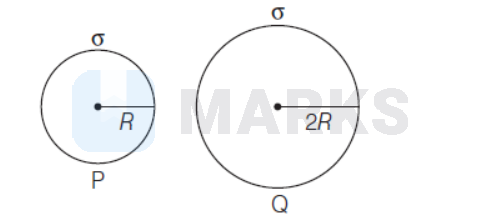
$$ \begin{gathered} \mathrm{Q}_{\mathrm{P}}=\sigma \times 4 \pi \mathrm{R}^2=4 \pi \sigma \mathrm{R}^2 \\ \text { and } \mathrm{Q}_{\mathrm{Q}}=\sigma \times 4 \pi(2 \mathrm{R})^2=16 \pi \sigma \mathrm{R}^2 \end{gathered} $$ when they are brought in contact with each other, the total charge will be $$ \begin{aligned} \mathrm{Q}_{\mathrm{t}} & =\mathrm{Q}_{\mathrm{P}}+\mathrm{Q}_{\mathrm{Q}} \\ = & 4 \pi \sigma \mathrm{R}^2+16 \pi \sigma \mathrm{R}^2 \text { [From Eq. (i) and (ii)] } \\ & =20 \pi \sigma \mathrm{R}^2 \end{aligned} $$ In connection of two charged conducting bodies, the potential will become same on both, i.e. $$ \begin{aligned} \frac{\mathrm{Q}_{\mathrm{P}}}{4 \pi \in_0 \mathrm{R}}=\frac{\mathrm{Q}_{\mathrm{Q}}}{4 \pi \epsilon_0 2 \mathrm{R}} \\ \Rightarrow \quad \frac{\mathrm{Q}_{\mathrm{P}}}{\mathrm{R}}=\frac{\mathrm{Q}_{\mathrm{Q}}}{2 \mathrm{R}} \Rightarrow \frac{\mathrm{Q}_{\mathrm{P}}}{\mathrm{Q}_{\mathrm{Q}}}=\frac{1}{2} \end{aligned} $$ So, the charges on the sphere $\mathrm{P}$ and $\mathrm{Q}$ after separation will be distributed as $$ \Rightarrow \quad Q_P^{\prime}=\frac{1}{3} Q_{\mathrm{t}} \text { and } \mathrm{Q}_{\mathrm{Q}}^{\prime}=\frac{2}{3} \mathrm{Q}_{\mathrm{t}} $$ After separation, the new surface charge densities on $\mathrm{P}$ and $\mathrm{Q}$ will be $$ \begin{aligned} \sigma_{\mathrm{P}}=\frac{\mathrm{Q}_{\mathrm{P}}^{\prime}}{\text { Area }} & =\frac{1}{3} \frac{\mathrm{Q}_{\mathrm{t}}}{\text { Area }}=\frac{1}{3} \frac{20 \pi \sigma \mathrm{R}^2}{4 \pi \mathrm{R}^2}=\frac{5}{3} \sigma \\ \text { and } \sigma_{\mathrm{Q}}=\frac{\mathrm{Q}_{\mathrm{Q}}^{\prime}}{\text { Area }} & =\frac{2}{3} \frac{\mathrm{Q}_{\mathrm{t}}}{\text { Area }}=\frac{2}{3} \times \frac{20 \pi \sigma \mathrm{R}^2}{4 \pi(2 \mathrm{R})^2} \\ & =\frac{2}{3} \times \frac{5}{4} \sigma=\frac{5}{6} \sigma \end{aligned} $$
$$ \begin{gathered} \mathrm{Q}_{\mathrm{P}}=\sigma \times 4 \pi \mathrm{R}^2=4 \pi \sigma \mathrm{R}^2 \\ \text { and } \mathrm{Q}_{\mathrm{Q}}=\sigma \times 4 \pi(2 \mathrm{R})^2=16 \pi \sigma \mathrm{R}^2 \end{gathered} $$ when they are brought in contact with each other, the total charge will be $$ \begin{aligned} \mathrm{Q}_{\mathrm{t}} & =\mathrm{Q}_{\mathrm{P}}+\mathrm{Q}_{\mathrm{Q}} \\ = & 4 \pi \sigma \mathrm{R}^2+16 \pi \sigma \mathrm{R}^2 \text { [From Eq. (i) and (ii)] } \\ & =20 \pi \sigma \mathrm{R}^2 \end{aligned} $$ In connection of two charged conducting bodies, the potential will become same on both, i.e. $$ \begin{aligned} \frac{\mathrm{Q}_{\mathrm{P}}}{4 \pi \in_0 \mathrm{R}}=\frac{\mathrm{Q}_{\mathrm{Q}}}{4 \pi \epsilon_0 2 \mathrm{R}} \\ \Rightarrow \quad \frac{\mathrm{Q}_{\mathrm{P}}}{\mathrm{R}}=\frac{\mathrm{Q}_{\mathrm{Q}}}{2 \mathrm{R}} \Rightarrow \frac{\mathrm{Q}_{\mathrm{P}}}{\mathrm{Q}_{\mathrm{Q}}}=\frac{1}{2} \end{aligned} $$ So, the charges on the sphere $\mathrm{P}$ and $\mathrm{Q}$ after separation will be distributed as $$ \Rightarrow \quad Q_P^{\prime}=\frac{1}{3} Q_{\mathrm{t}} \text { and } \mathrm{Q}_{\mathrm{Q}}^{\prime}=\frac{2}{3} \mathrm{Q}_{\mathrm{t}} $$ After separation, the new surface charge densities on $\mathrm{P}$ and $\mathrm{Q}$ will be $$ \begin{aligned} \sigma_{\mathrm{P}}=\frac{\mathrm{Q}_{\mathrm{P}}^{\prime}}{\text { Area }} & =\frac{1}{3} \frac{\mathrm{Q}_{\mathrm{t}}}{\text { Area }}=\frac{1}{3} \frac{20 \pi \sigma \mathrm{R}^2}{4 \pi \mathrm{R}^2}=\frac{5}{3} \sigma \\ \text { and } \sigma_{\mathrm{Q}}=\frac{\mathrm{Q}_{\mathrm{Q}}^{\prime}}{\text { Area }} & =\frac{2}{3} \frac{\mathrm{Q}_{\mathrm{t}}}{\text { Area }}=\frac{2}{3} \times \frac{20 \pi \sigma \mathrm{R}^2}{4 \pi(2 \mathrm{R})^2} \\ & =\frac{2}{3} \times \frac{5}{4} \sigma=\frac{5}{6} \sigma \end{aligned} $$
Hence, the correct answer is option: 'D'.