Q13 / 60 · JEE Advanced 2012 (Paper 1) · Chemistry
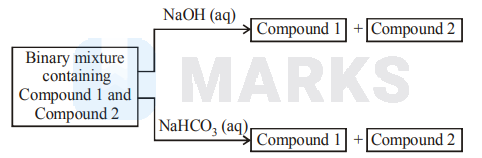
Identify the binary mixture(s) that can be separated into individual compounds, by differential extraction as shown in the given scheme.
- A$\mathrm{C}_{6} \mathrm{H}_{5} \mathrm{OH}$ and $\mathrm{C}_{6} \mathrm{H}_{5} \mathrm{COOH}$
- Correct answerB$\mathrm{C}_{6} \mathrm{H}_{5} \mathrm{COOH}$ and $\mathrm{C}_{6} \mathrm{H}_{5} \mathrm{CH}_{2} \mathrm{OH}$
- C$\mathrm{C}_{6} \mathrm{H}_{5} \mathrm{CH}_{2} \mathrm{OH}$ and $\mathrm{C}_{6} \mathrm{H}_{5} \mathrm{OH}$
- Correct answerD$\mathrm{C}_{6} \mathrm{H}_{5} \mathrm{CH}_{2} \mathrm{OH}$ and $\mathrm{C}_{6} \mathrm{H}_{5} \mathrm{CH}_{2} \mathrm{COOH}$
Solution
(a) Both are soluble in $\mathrm{NaOH}$. Hence, inseparable.
(b) Only benzoic acid $\left(\mathrm{C}_{6} \mathrm{H}_{5} \mathrm{COOH}\right)$ is soluble in $\mathrm{NaOH}$ and $\mathrm{NaHCO}_{3}$, while benzyl alcohol $\left(\mathrm{C}_{6} \mathrm{H}_{5} \mathrm{CH}_{2} \mathrm{OH}\right)$ is not. Hence, separable.
(c) Although $\mathrm{NaOH}$ can enable separation between benzyl alcohol $\left(\mathrm{C}_{6} \mathrm{H}_{5} \mathrm{CH}_{2} \mathrm{OH}\right)$ and phenol $\left(\mathrm{C}_{6} \mathrm{H}_{5} \mathrm{OH}\right)$ as only the latter is soluble in $\mathrm{NaOH}$. However, in $\mathrm{NaHCO}_{3}$, both are insoluble. Hence, inseparable.
(d) $\alpha$-Phenylacetic acid $\left(\mathrm{C}_{6} \mathrm{H}_{5} \mathrm{CH}_{2} \mathrm{COOH}\right)$ is soluble in $\mathrm{NaOH}$ and $\mathrm{NaHCO}_{3}$, while benzyl alcohol $\left(\mathrm{C}_{6} \mathrm{H}_{5} \mathrm{CH}_{2} \mathrm{OH}\right)$ is not. Hence, separable.
Hence, the correct answer is options: 'B', 'D'.