Q18 / 54 · JEE Advanced 2026 (Paper 2) · Chemistry
Passage: Consider the following reaction sequence in which $\textbf{J}$, $\textbf{K}$, $\textbf{L}$ and $\textbf{M}$ are the major products.
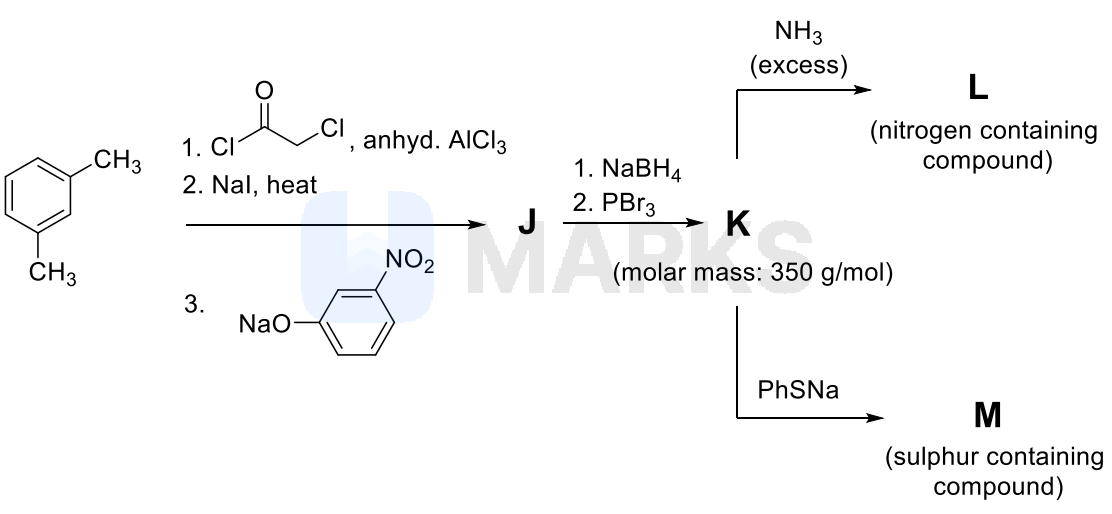
Given:
Atomic mass (in amu): H : $1$, C : $12$, N : $14$, O : $16$, S : $32$, Br : $80$, Ba : $137$
Question: In sulphur estimation by Carius method, the amount of BaSO$_4$ formed from $3.79$ g of $\textbf{M}$ is ____ g.
Given:
Atomic mass (in amu): H : $1$, C : $12$, N : $14$, O : $16$, S : $32$, Br : $80$, Ba : $137$
Question: In sulphur estimation by Carius method, the amount of BaSO$_4$ formed from $3.79$ g of $\textbf{M}$ is ____ g.
Correct answer: 2.33
Solution
Step 1: The starting material is $m$-xylene (1,3-dimethylbenzene). It undergoes Friedel-Crafts acylation with chloroacetyl chloride ($\text{ClCH}_2\text{COCl}$) in the presence of anhydrous $\text{AlCl}_3$ to form 2-chloro-1-(2,4-dimethylphenyl)ethanone.
Step 2: The chloro ketone reacts with $\text{NaI}$ (Finkelstein reaction) to form 2-iodo-1-(2,4-dimethylphenyl)ethanone.
Step 3: This iodo compound undergoes Williamson ether synthesis with sodium 3-nitrophenoxide to form compound $\textbf{J}$.
The molecular formula of $\textbf{J}$ is $\text{C}_{16}\text{H}_{15}\text{NO}_4$.
Step 4: Compound $\textbf{J}$ is reduced by $\text{NaBH}_4$, which converts the ketone group to a secondary alcohol. Subsequent reaction with $\text{PBr}_3$ replaces the hydroxyl group with a bromine atom, yielding compound $\textbf{K}$.
The molecular formula of $\textbf{K}$ is $\text{C}_{16}\text{H}_{16}\text{BrNO}_3$.
Molar mass of $\textbf{K} = (16 \times 12) + (16 \times 1) + 80 + 14 + (3 \times 16) = 350 \text{ g/mol}$, which matches the given data.
Step 5: Compound $\textbf{K}$ reacts with sodium thiophenoxide ($\text{PhSNa}$) in an $\text{S}_\text{N}2$ reaction, replacing the bromide with a phenylthio group ($\text{-SPh}$) to form compound $\textbf{M}$.
The molecular formula of $\textbf{M}$ is $\text{C}_{16}\text{H}_{16}(\text{SC}_6\text{H}_5)\text{NO}_3 \Rightarrow \text{C}_{22}\text{H}_{21}\text{NO}_3\text{S}$.
Molar mass of $\textbf{M} = 350 - 80 (\text{for Br}) + 109 (\text{for SPh}) = 379 \text{ g/mol}$.
Step 6: Calculate the moles of compound $\textbf{M}$ used in the Carius method.
$\text{Moles of } \textbf{M} = \dfrac{3.79 \text{ g}}{379 \text{ g/mol}} = 0.01 \text{ mol}$.
Step 7: Since each molecule of $\textbf{M}$ contains exactly one sulphur atom, the moles of sulphur present is $0.01 \text{ mol}$. In the Carius method, all sulphur is quantitatively converted to barium sulphate ($\text{BaSO}_4$).
$\text{Moles of BaSO}_4 \text{ formed} = 0.01 \text{ mol}$.
Step 8: Calculate the mass of $\text{BaSO}_4$ formed.
Molar mass of $\text{BaSO}_4 = 137 (\text{Ba}) + 32 (\text{S}) + 4 \times 16 (\text{O}) = 233 \text{ g/mol}$.
$\text{Mass of BaSO}_4 = 0.01 \text{ mol} \times 233 \text{ g/mol} = 2.33 \text{ g}$.
Answer: $2.33$
Hence, the correct answer is 2.33.