Q23 / 180 · COMEDK 2026 (9 May Shift 2) · Chemistry
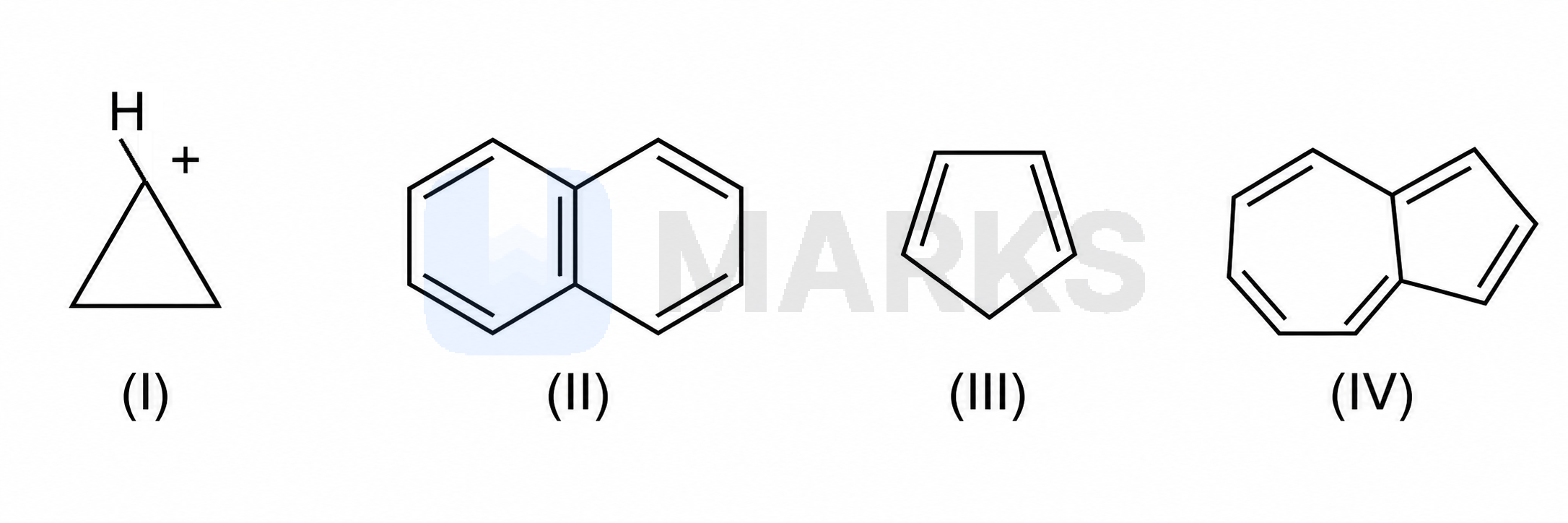
Identify the aromatic compounds among the given set based on Huckel's rule:
- Correct answerAI, II, IV
- BII, III, IV
- CI, II, III
- DI, III, IV
Solution
According to Huckel's rule, a compound is aromatic if it is cyclic, planar, fully conjugated, and has $(4n + 2)$ $\pi$ electrons, where $n = 0, 1, 2, \dots$
Compound (I): Cyclopropenyl cation is cyclic, planar, and fully conjugated. It has $2$ $\pi$ electrons. $4n + 2 = 2 \Rightarrow n = 0$. Thus, it is aromatic.
Compound (II): Naphthalene is cyclic, planar, and fully conjugated. It has $10$ $\pi$ electrons ($5$ double bonds). $4n + 2 = 10 \Rightarrow n = 2$. Thus, it is aromatic.
Compound (III): Cyclopentadiene contains an $sp^3$ hybridized carbon atom, which breaks the continuous conjugation. Thus, it is non-aromatic.
Compound (IV): Azulene is cyclic, planar, and fully conjugated. It has $10$ $\pi$ electrons ($5$ double bonds). $4n + 2 = 10 \Rightarrow n = 2$. Thus, it is aromatic.
Therefore, compounds I, II, and IV are aromatic.
Answer: I, II, IV
Hence, the correct answer is option: 'A'.