Q5 / 180 · COMEDK 2024 (Evening Shift) · Chemistry
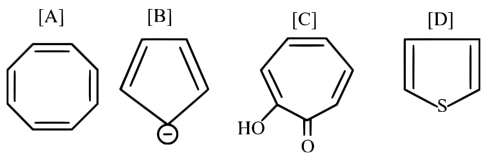
Identify the compound which is non-aromatic in nature.
- AD
- BC
- Correct answerCA
- DB
Solution
To determine the aromaticity of the given compounds, we apply Huckel's rule, which states that a planar, cyclic, fully conjugated system with $(4n+2)$ $\pi$ electrons is aromatic, while one with $4n$ $\pi$ electrons is anti-aromatic. If the molecule is not planar or lacks continuous conjugation, it is non-aromatic.
Compound [A] is cyclooctatetraene. It has $8$ $\pi$ electrons ($4n$ system). However, it adopts a non-planar 'tub' shape to minimize angle strain and avoid anti-aromaticity, making it non-aromatic.
Compound [B] is the cyclopentadienyl anion. It has $6$ $\pi$ electrons ($4n+2$ with $n=1$), is planar, and fully conjugated, making it aromatic.
Compound [C] is tropolone. It is a planar, cyclic, conjugated system with $6$ $\pi$ electrons in the ring (considering the resonance structure with the oxygen atom), making it aromatic.
Compound [D] is thiophene. It has $6$ $\pi$ electrons ($4$ from the double bonds and $2$ from the lone pair on sulfur), is planar, and fully conjugated, making it aromatic.
Therefore, cyclooctatetraene [A] is the non-aromatic compound.
Answer: A
Hence, the correct answer is option: 'C'.