Q77 / 200 · NEET 2006 · Chemistry
For the reaction, $2 \mathrm{~A}+\mathrm{B} \rightarrow 3 \mathrm{C}+\mathrm{D}$, which of the following does not express the reaction rate?
- A$-\frac{d[\mathrm{~A}]}{d t}$
- Correct answerB$-\frac{d[\mathrm{C}]}{3 d t}$
- C$-\frac{d[\mathrm{~B}]}{d t}$
- D$\frac{d[\mathrm{D}]}{d t}$
Solution
For the reaction $2 \mathrm{~A}+\mathrm{B} \rightarrow 3 \mathrm{C}+\mathrm{D}$. The reaction rate is written as follows:
The reaction rate w.r.t. $\mathrm{A}=-\frac{1}{2} \frac{d[\mathrm{~A}]}{d t}$
The reaction rate w.r.t. $\mathrm{B}=-\frac{d[\mathrm{~B}]}{d t}$
The reaction rate w.r.t. $\mathrm{C}=+\frac{1}{3} \frac{d[\mathrm{C}]}{d t}$
The reaction rate w.r.t. $\mathrm{D}=+\frac{d[\mathrm{D}]}{d t}$
Related Theory
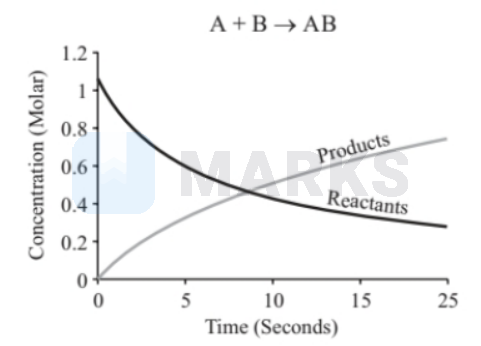
During the course of the reaction shown below, reactants $A$ and $B$ are consumed while the concentration of product $A B$ increases. The reaction rate can be determined by measuring how fast the concentration of $A$ or $B$ decreases, or by how fast the concentration of $A B$ increases.
Caution The reaction rate is dependent on the concentration of the reactants as well as the rate constant as well as other factors include temperature and catalysts.
Caution The reaction rate is dependent on the concentration of the reactants as well as the rate constant as well as other factors include temperature and catalysts.
Hence, the correct answer is option: 'B'.