Q56 / 180 · NEET 2026 (Re-NEET) · Chemistry
Consider the following reaction, and choose the correct option.
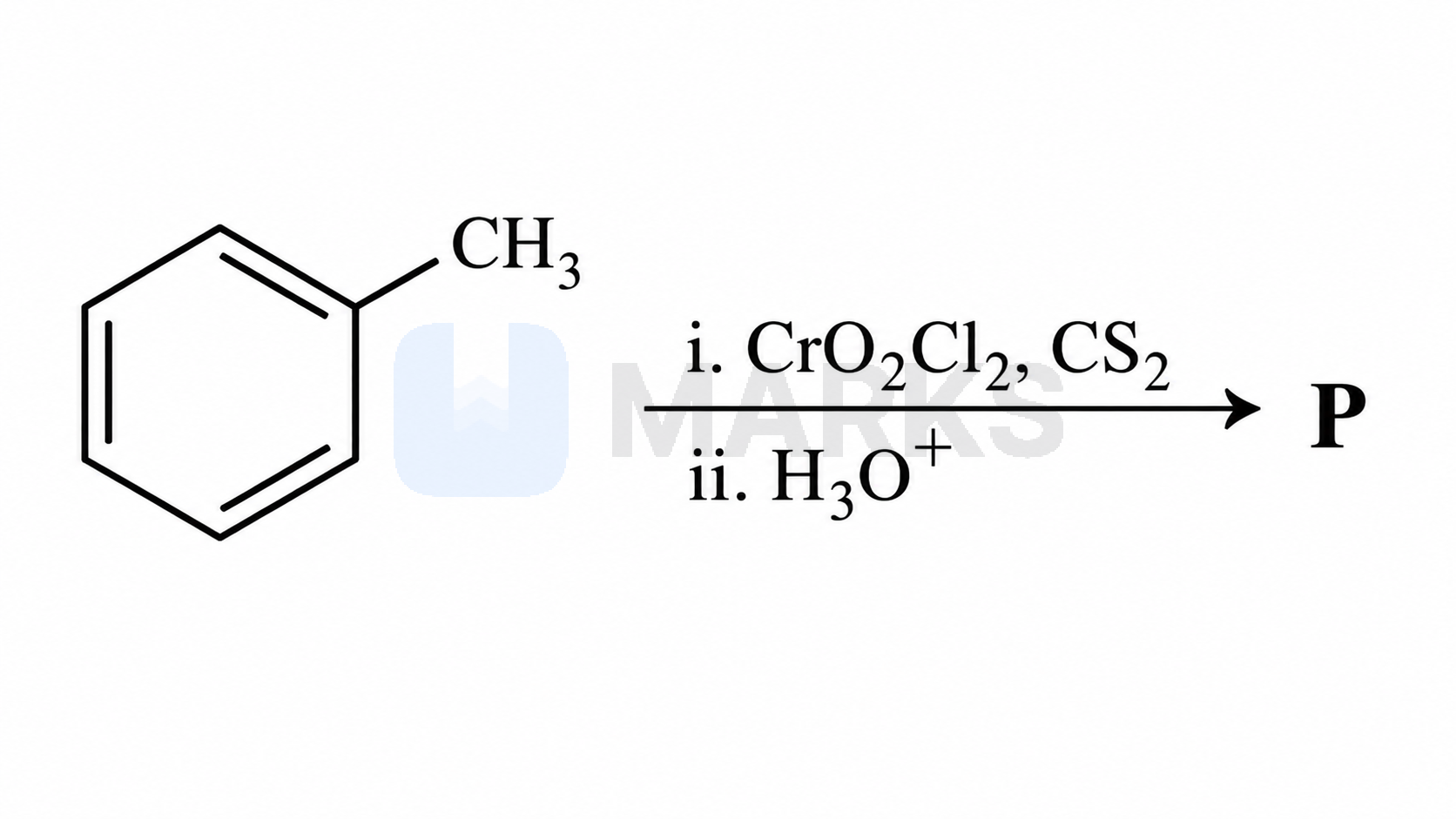
- Correct answerACompound $\text{P}$ is obtained by the hydrogenation of benzoyl chloride with Pd on BaSO$_4$.
- BOn treating compound $\text{P}$ with saturated NaHCO$_3$ solution, brisk effervescence is observed.
- CCompound $\text{P}$ can be prepared by treating benzene with anhydrous AlCl$_3$ and CH$_3$COCl.
- DOn treatment with bromine water, compound $\text{P}$ gives a white precipitate.
Solution
The given reaction is the Etard reaction. Toluene reacts with chromyl chloride ($\text{CrO}_2\text{Cl}_2$) in a non-polar solvent like $\text{CS}_2$ to form a chromium complex, which upon acid hydrolysis ($\text{H}_3\text{O}^+$) yields benzaldehyde.
Therefore, compound $\text{P}$ is benzaldehyde ($\text{C}_6\text{H}_5\text{CHO}$).
Let us evaluate the given options:
Option (1): The hydrogenation of benzoyl chloride ($\text{C}_6\text{H}_5\text{COCl}$) with $\text{H}_2$ in the presence of Pd supported on $\text{BaSO}_4$ is known as the Rosenmund reduction. This reaction yields benzaldehyde. Thus, this statement is correct.
Option (2): Benzaldehyde does not react with saturated $\text{NaHCO}_3$ solution to give brisk effervescence. This test is characteristic of carboxylic acids.
Option (3): Treating benzene with anhydrous $\text{AlCl}_3$ and acetyl chloride ($\text{CH}_3\text{COCl}$) is a Friedel-Crafts acylation reaction, which produces acetophenone ($\text{C}_6\text{H}_5\text{COCH}_3$), not benzaldehyde.
Option (4): Benzaldehyde does not give a white precipitate with bromine water. The bromine water test giving a white precipitate is characteristic of phenol and aniline.
Answer: Compound $\text{P}$ is obtained by the hydrogenation of benzoyl chloride with Pd on BaSO$_4$.
Hence, the correct answer is option: 'A'.