Q96 / 180 · NEET 2026 (Re-NEET) · Chemistry
Consider the following reaction sequences and choose the correct option.
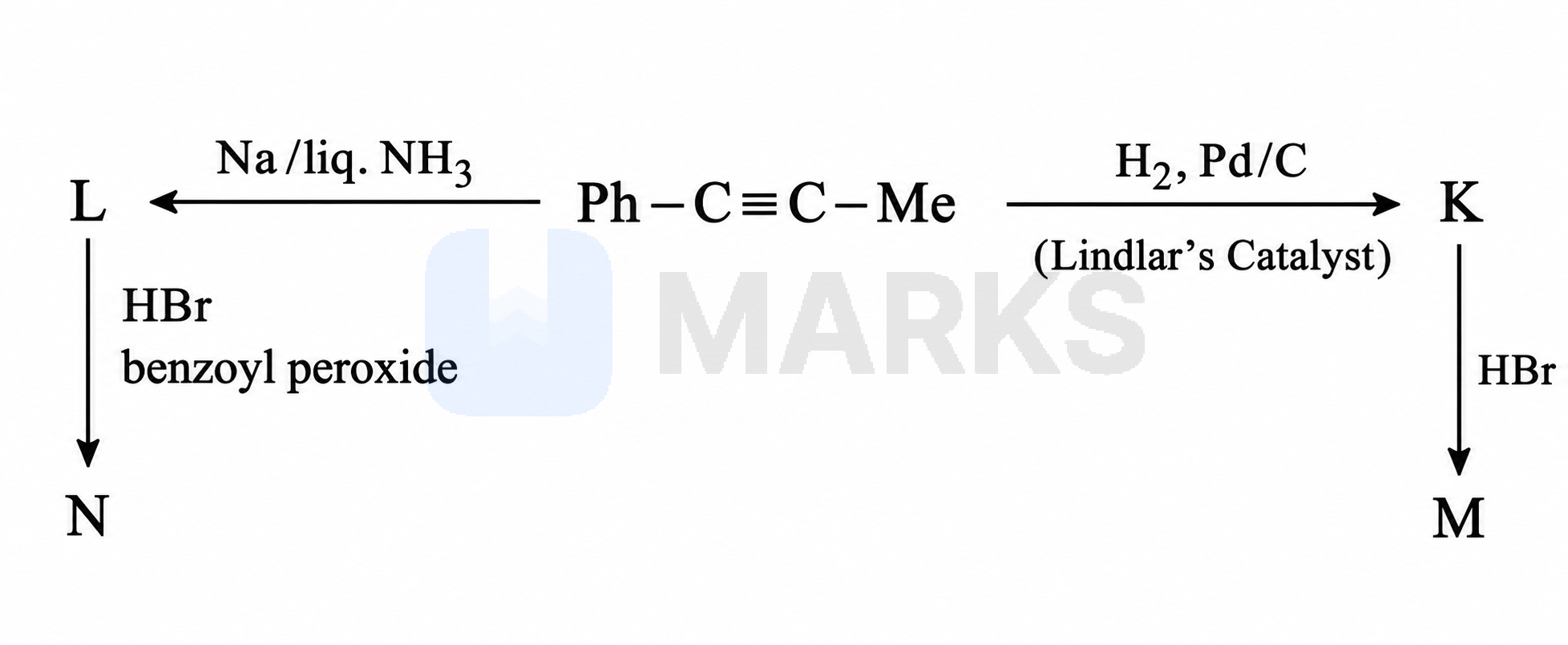
- A$\text{M}$ and $\text{N}$ are stereoisomers
- Correct answerB$\text{K}$ and $\text{L}$ are geometrical isomers
- C$\text{K}$ and $\text{L}$ are enantiomers
- D$\text{M}$ and $\text{N}$ are geometrical isomers
Solution
The given starting material is 1-phenylpropyne, $\text{Ph}-\text{C}\equiv\text{C}-\text{Me}$.
Reduction of the alkyne with $\text{H}_2$ in the presence of Lindlar's catalyst ($\text{Pd/C}$ poisoned with $\text{BaSO}_4$ or quinoline) proceeds via syn-addition. This yields the cis-alkene. Therefore, $\text{K}$ is cis-1-phenylpropene.
Reduction of the alkyne with $\text{Na}$ in liquid $\text{NH}_3$ (Birch reduction conditions) proceeds via anti-addition. This yields the trans-alkene. Therefore, $\text{L}$ is trans-1-phenylpropene.
Since $\text{K}$ is the cis-isomer and $\text{L}$ is the trans-isomer of the same compound, they are geometrical isomers.
Further reactions:
Addition of $\text{HBr}$ to $\text{K}$ is an electrophilic addition that proceeds via the more stable benzylic carbocation ($\text{Ph}-\text{C}^+\text{H}-\text{CH}_2-\text{Me}$). This gives 1-bromo-1-phenylpropane as product $\text{M}$.
Addition of $\text{HBr}$ to $\text{L}$ in the presence of benzoyl peroxide is a free radical addition (anti-Markovnikov). The bromine radical adds to form the more stable benzylic radical ($\text{Ph}-\text{C}^\bullet\text{H}-\text{CH}(\text{Br})-\text{Me}$). This gives 2-bromo-1-phenylpropane as product $\text{N}$.
$\text{M}$ and $\text{N}$ are positional isomers (constitutional isomers), not stereoisomers.
Thus, the only correct statement is that $\text{K}$ and $\text{L}$ are geometrical isomers.
Answer: $\text{K}$ and $\text{L}$ are geometrical isomers
Hence, the correct answer is option: 'B'.