Q136 / 170 · Manipal (MET) 2016 · Physics
A thin dielectric rod of length $l$ lies along $X$-axis. One end of the rod is placed at the origin and the other end of the rod is placed at $(l, 0)$. A total charge $Q$ is distributed uniformly along the length of the rod. What is the potential at a point $(x, 0)$ when $x\gt1$ ?
- A$\frac{Q}{4 \pi \varepsilon_0} \cdot \log _e\left(\frac{x}{x-1}\right)$
- B$\frac{Q}{4 \pi \varepsilon_0 l} \cdot \log _\theta\left(\frac{x}{l}\right)$
- Correct answerC$\frac{Q}{4 \pi \varepsilon_0 l} \cdot \log _e\left(\frac{x-l}{x}\right)$
- D$\frac{Q}{4 \pi \varepsilon_0 l}$
Solution
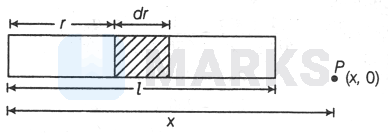
The potential due to a small element of length $d r$ having charge $d Q$ of the dielectric rod is given by $d V=\frac{d Q}{4 \pi \varepsilon_0 r}$ or $d V=\frac{\lambda d r}{4 \pi \varepsilon_0 r} \quad\left[\begin{array}{c}\because \lambda=\frac{d Q}{d r}, \\ \lambda d r=d Q\end{array}\right]$ or $V=\frac{\lambda}{4 \pi \varepsilon_0} \int_x^{x-l} \frac{d r}{r}$ $\begin{aligned} & =\frac{\lambda}{4 \pi \varepsilon_0}\left[\log _e r\right]_x^{x-l} \\ & =\frac{\lambda}{4 \pi \varepsilon_0} \cdot \log \left(\frac{x-l}{x}\right)\end{aligned}$ $V=\frac{Q}{4 \pi \varepsilon_0 1} \cdot \log e\left(\frac{x-l}{x}\right)$ When $\lambda=\frac{Q}{l}$ (for whole length of rod)
Hence, the correct answer is option: 'C'.