Q78 / 79 · NEST (NISER) 2026 · Physics
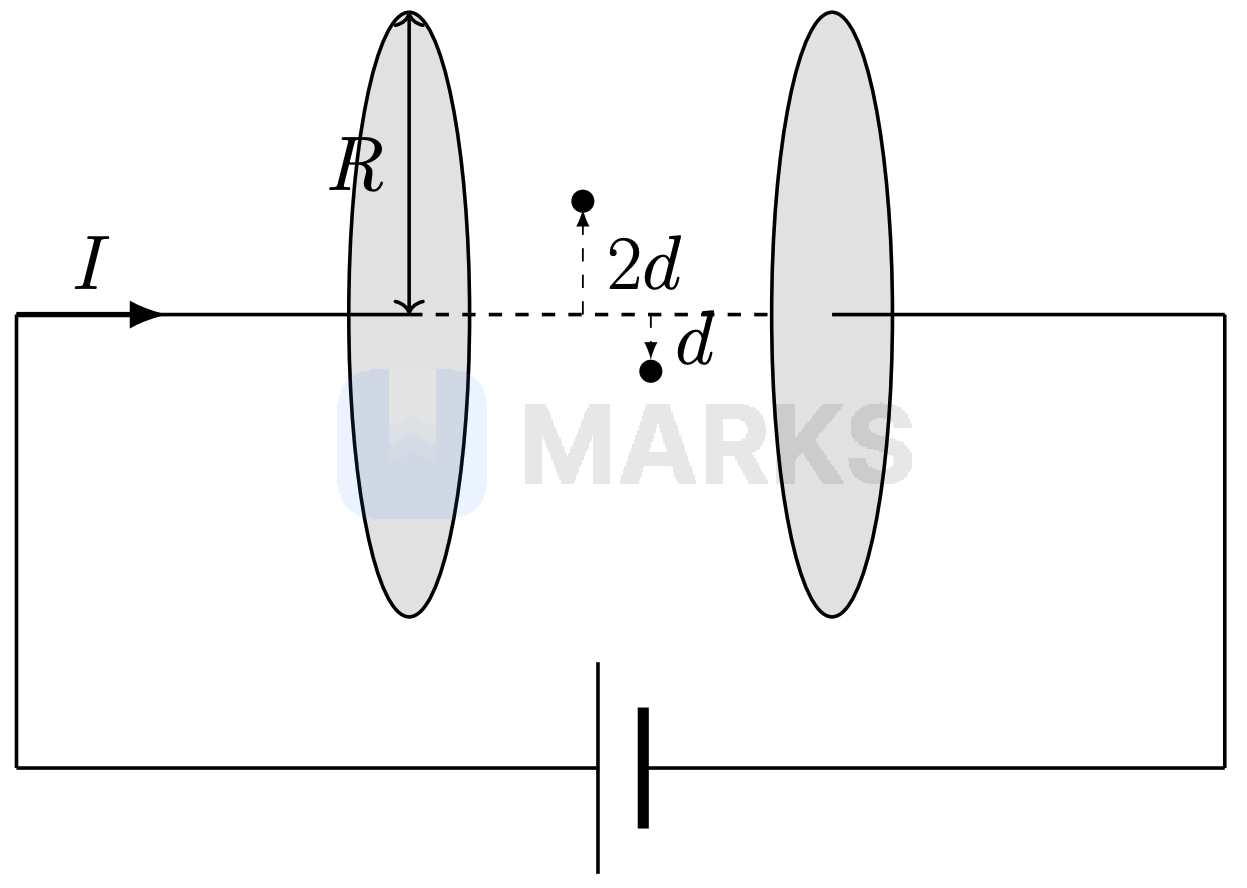
A parallel plate capacitor with circular plates of radius $R$ is being charged as shown in the figure. Let $B(r)$ be the induced magnetic field at a distance $r$ from the central axis between the plates. Assuming $d \ll R$, the ratio $\dfrac{B(2d)}{B(d)}$, while charging, is
- Correct answerA$2$
- B$1$
- C$\dfrac{1}{2}$
- D$\dfrac{1}{4}$
Solution
Inside the parallel plate capacitor, the electric field $E$ is uniform and changes with time as the capacitor charges.
According to the Ampere-Maxwell law, the induced magnetic field $B$ along a circular loop of radius $r$ (where $r < R$) is given by:
$\oint \vec{B} \cdot d\vec{l} = \mu_0 \epsilon_0 \dfrac{d\Phi_E}{dt}$
$B(r) \cdot 2\pi r = \mu_0 \epsilon_0 \dfrac{d}{dt} (E \cdot \pi r^2)$
$B(r) \cdot 2\pi r = \mu_0 \epsilon_0 \pi r^2 \dfrac{dE}{dt}$
$B(r) = \dfrac{\mu_0 \epsilon_0 r}{2} \dfrac{dE}{dt}$
Since $\dfrac{dE}{dt}$ is constant across the cross-section, the induced magnetic field $B(r)$ is directly proportional to the distance $r$ from the central axis, i.e., $B(r) \propto r$.
Given $d \ll R$, both points at distances $d$ and $2d$ lie well inside the region between the plates.
Therefore, the ratio of the magnetic fields is:
$\dfrac{B(2d)}{B(d)} = \dfrac{2d}{d} = 2$
Answer: $2$
Hence, the correct answer is option: 'A'.