Q109 / 125 · BITSAT 2015 · Physics
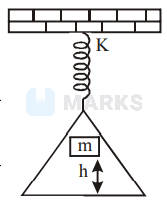
A load of mass m falls from a height h on to the scale pan hung from the spring as shown in the figure. If the spring constant is $\mathrm{k}$ and mass of the scale pan is zero and the mass $\mathrm{m}$ does not bounce relative to the pan, then the amplitude of vibration is
- A$\mathrm{mg} / \mathrm{d}$
- Correct answerB$\frac{\mathrm{mg}}{\mathrm{k}} \sqrt{\left(\frac{1+2 \mathrm{hk}}{\mathrm{mg}}\right)}$
- C$\frac{\mathrm{mg}}{\mathrm{k}}+\frac{\mathrm{mg}}{\mathrm{k}} \sqrt{\left(\frac{1+2 \mathrm{hk}}{\mathrm{mg}}\right)}$
- D$\frac{\mathrm{mg}}{\mathrm{k}} \sqrt{\left(\frac{1+2 \mathrm{hk}}{\mathrm{mg}}-\frac{\mathrm{mg}}{\mathrm{k}}\right)}$
Solution
According to energy conservation principle, If, $\mathrm{x}_{1}$ is maximum elongation in the spring when the particle is in its lowest extreme position. Then,
$$
\begin{array}{l}
\mathrm{mgh}=\frac{1}{2} \mathrm{kx}_{1}^{2}-\mathrm{mgx}_{1} \\
\Rightarrow \frac{1}{2} \mathrm{kx}_{1}^{2}-\mathrm{mgx}_{1}-\mathrm{mgh}=0 \\
\text { or, } \mathrm{x}_{1}^{2}-\frac{2 \mathrm{mg}}{\mathrm{k}} \mathrm{x}_{1}-\frac{2 \mathrm{mg}}{\mathrm{k}} \cdot \mathrm{h}=0 \\
\therefore \mathrm{x}_{1}=\frac{\frac{2 \mathrm{mg}}{\mathrm{k}} \pm \sqrt{\left.\left(\frac{2 \mathrm{mg}}{\mathrm{k}}\right)^{2}+4 \times \frac{2 \mathrm{mg}}{\mathrm{k}} \mathrm{h}\right]}}{2}
\end{array}
$$
Amplitude $\mathrm{A}=\mathrm{X}_{1}-\mathrm{X}_{0}$ (elongation in spring for equilibrium position)
$$
\mathrm{A}=\frac{\mathrm{mg}}{\mathrm{k}} \sqrt{\left(1+\frac{2 \mathrm{hk}}{\mathrm{mg}}\right)}
$$
Hence, the correct answer is option: 'B'.