Q92 / 200 · NEET 2012 (Screening) · Chemistry
Which one of the following is an outer orbital complex and exhibits paramagnetic behaviour?
- Correct answerA$\left[\mathrm{Ni}\left(\mathrm{NH}_3\right)_6\right]^{2+}$
- B$\left[\mathrm{Zn}\left(\mathrm{NH}_3\right)_6\right]^{2+}$
- C$\left[\mathrm{Cr}\left(\mathrm{NH}_3\right)_6\right]^{3+}$
- D$\left[\mathrm{Co}\left(\mathrm{NH}_3\right)_6\right]^{3+}$
Solution
Outer orbital complex utilises nd orbitals for bonding and exhibit paramagnetic behaviour, only if there present unpaired electrons.
$\begin{aligned}
& \text {(a) } \operatorname{In}\left[\mathrm{Ni}\left(\mathrm{NH}_3\right)_6\right]^{2+}: \\
& \mathrm{Ni}^{2+}=[\mathrm{Ar}] 3 d^8 4 s^0
\end{aligned}$

 So, this is an outer orbital complex having paramagnetic character.
(b) In $\left[\mathrm{Zn}\left(\mathrm{NH}_3\right)_6\right]^{2+}$ :
$\mathrm{Zn}^{2+}=[\mathrm{Ar}] 3 d^{10}$
 Thus, it is also an outer orbital complex but it is diamagnetic as all the electrons are paired.
$\begin{gathered}
\text {(c) } \operatorname{In}\left[\mathrm{Cr}\left(\mathrm{NH}_3\right)_6\right]^{3+} \\
\mathrm{Cr}^{3+}=[\mathrm{Ar}] 3 d^3 \\
{\left[\mathrm{Cr}\left(\mathrm{NH}_3\right)_6\right]^{3+}=}
\end{gathered}$
 Because of the involvement of $(n-1) d$, i.e., $3 d$ orbital in hybridisation, it is an inner orbital complex. Its nature is paramagnetic because of the presence of three unpaired electrons.
$\begin{aligned}
& \text{(d) } \operatorname{In}\left[\mathrm{Co}\left(\mathrm{NH}_3\right)_6\right]^{3+} \text { : } \\
& \mathrm{Co}^{3+}=[\mathrm{Ar}] 3 d^6
\end{aligned}$
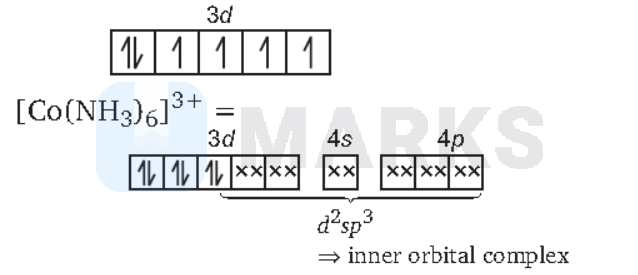 As all the electrons are paired, it is a diamagnetic complex.
So, this is an outer orbital complex having paramagnetic character.
(b) In $\left[\mathrm{Zn}\left(\mathrm{NH}_3\right)_6\right]^{2+}$ :
$\mathrm{Zn}^{2+}=[\mathrm{Ar}] 3 d^{10}$
Thus, it is also an outer orbital complex but it is diamagnetic as all the electrons are paired.
$\begin{gathered}
\text {(c) } \operatorname{In}\left[\mathrm{Cr}\left(\mathrm{NH}_3\right)_6\right]^{3+} \\
\mathrm{Cr}^{3+}=[\mathrm{Ar}] 3 d^3 \\
{\left[\mathrm{Cr}\left(\mathrm{NH}_3\right)_6\right]^{3+}=}
\end{gathered}$
Because of the involvement of $(n-1) d$, i.e., $3 d$ orbital in hybridisation, it is an inner orbital complex. Its nature is paramagnetic because of the presence of three unpaired electrons.
$\begin{aligned}
& \text{(d) } \operatorname{In}\left[\mathrm{Co}\left(\mathrm{NH}_3\right)_6\right]^{3+} \text { : } \\
& \mathrm{Co}^{3+}=[\mathrm{Ar}] 3 d^6
\end{aligned}$
As all the electrons are paired, it is a diamagnetic complex.Hence, the correct answer is option: 'A'.