Q40 / 155 · WBJEE 2026 · Chemistry
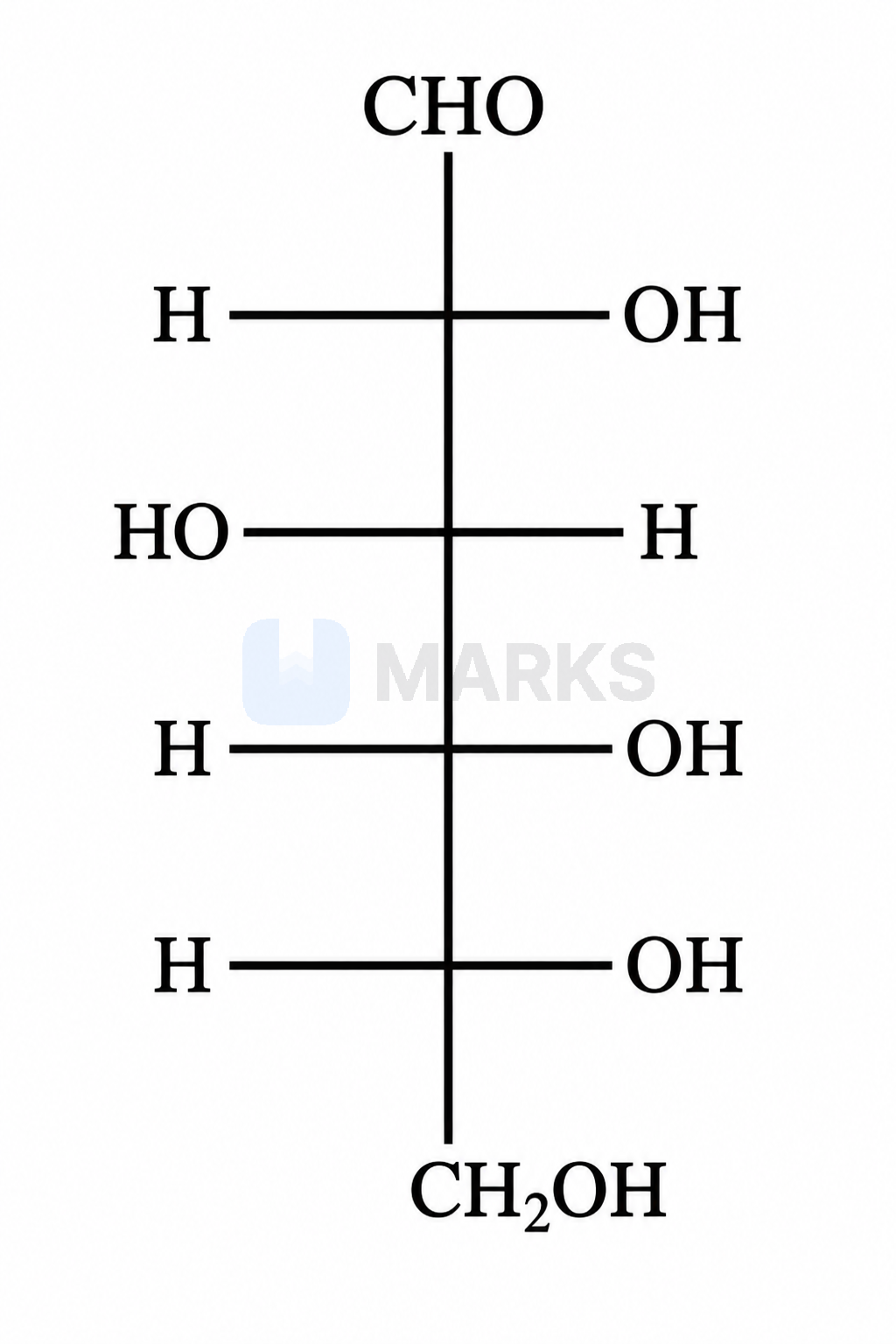
Which of the following statement(s) is/are correct about the given compound?
- Correct answerAIt exhibits ring-chain tautomerism
- Correct answerBIt forms osazone with phenylthydrazine
- CIt gives eight (8) stereoisomers
- Correct answerDIt responds to Tollen's reagent
Solution
The given compound is D-glucose, which is an aldohexose.
(A) D-glucose exhibits ring-chain tautomerism as it exists in an equilibrium between its open-chain aldehyde form and its cyclic hemiacetal forms ($\alpha$ and $\beta$ pyranose forms). Thus, this statement is correct.
(B) D-glucose reacts with three equivalents of phenylhydrazine to form glucosazone (an osazone). Thus, this statement is correct.
(C) The open-chain form of D-glucose has $4$ chiral centers. The total number of stereoisomers for this constitution is $2^4 = 16$, not $8$. Thus, this statement is incorrect.
(D) Being an aldose, it is a reducing sugar. The aldehyde group can be oxidized by Tollen's reagent, giving a positive test (silver mirror). Thus, this statement is correct.
Answer: It exhibits ring-chain tautomerism; It forms osazone with phenylthydrazine; It responds to Tollen's reagent
Hence, the correct answer is options: 'A', 'B', 'D'.