Q148 / 155 · WBJEE 2024 · Physics
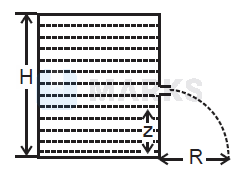
Water in filled in a cylindrical vessel of height H. A hole is made at height z from the bottom, as shown in the figure.
The value of of z for which the range (R) of the emerging water through the hole will be maximum for
- A$z=\frac{H}{4}$
- Correct answerB$\quad z=\frac{\mathrm{H}}{2}$
- C$z=\frac{\mathrm{H}}{8}$
- D$\quad z=\frac{H}{3}$
Solution
\(x=2 \sqrt{y(H-y)}\)
If hole is made at depth \(y=H-y\), then
\(\begin{aligned}
& X=2 \sqrt{(H-y)[H-(H-y)]} \\
& =2 \sqrt{y(H-y)} \\
& =x
\end{aligned}\)
Hence, range will remain same.
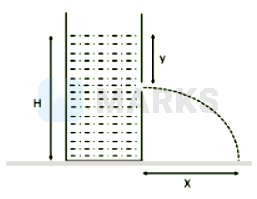 Now, \(\frac{d X}{d y}=\frac{1}{2}\left(y H-y^2\right)^{-1 / 2}(H-2 y)\)
For maximum value of \(X, \frac{d X}{d y}=0\)
\(\Rightarrow \frac{H-2 y}{2\left(y H-y^2\right)^{1 / 2}}=0\)
[Since denominator can't be zero, \(y \neq 0 \& y \neq H\) ]
\(\Rightarrow y=\frac{H}{2}\)
Now, \(\frac{d X}{d y}=\frac{1}{2}\left(y H-y^2\right)^{-1 / 2}(H-2 y)\)
For maximum value of \(X, \frac{d X}{d y}=0\)
\(\Rightarrow \frac{H-2 y}{2\left(y H-y^2\right)^{1 / 2}}=0\)
[Since denominator can't be zero, \(y \neq 0 \& y \neq H\) ]
\(\Rightarrow y=\frac{H}{2}\)Hence, the correct answer is option: 'B'.