Q192 / 240 · KCET 2026 · Physics
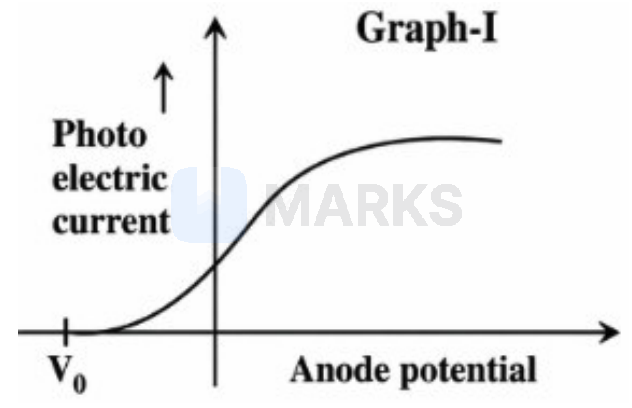
Variation of photoelectric current with anode potential is shown below. Choose the correct option ($V_0$ = stopping potential)
- Correct answerA
- B
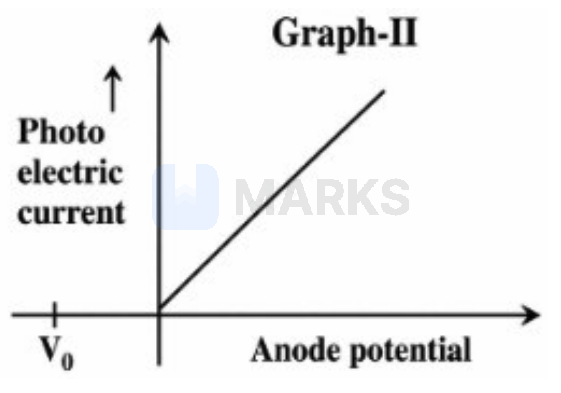
- C
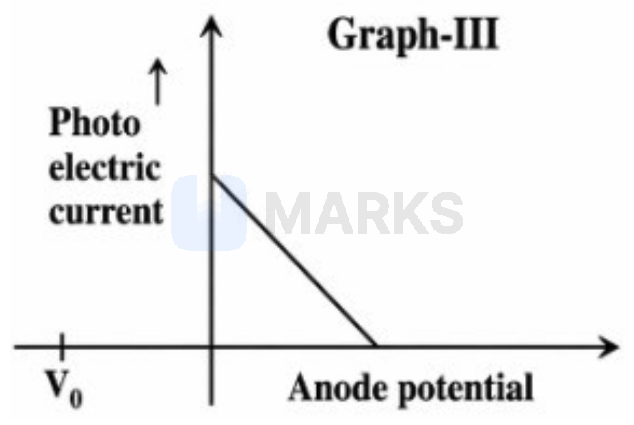
- D
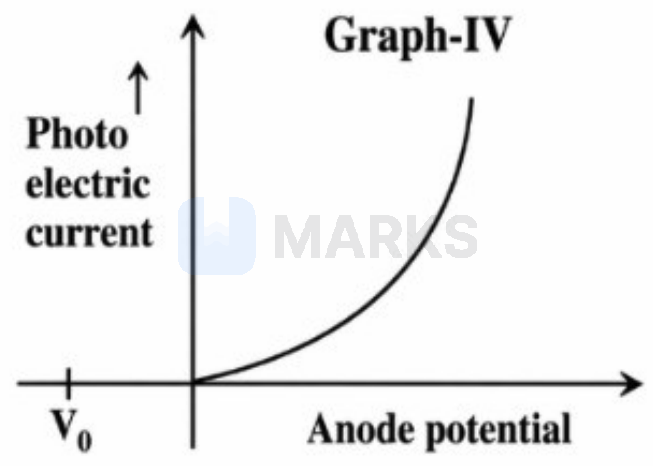
Solution
In the photoelectric effect, the variation of photoelectric current with anode potential has the following characteristics:
1. At zero anode potential, there is still some photoelectric current because the emitted photoelectrons possess initial kinetic energy and can reach the anode.
2. When a negative (retarding) potential is applied to the anode, the photoelectric current decreases. It becomes zero at a specific negative potential known as the stopping potential ($-V_0$).
3. As the positive anode potential is increased, the photoelectric current increases because more electrons are accelerated towards the anode.
4. Eventually, all emitted photoelectrons reach the anode, and the current reaches a maximum constant value called the saturation current. Further increasing the anode potential does not increase the current.
Graph-I correctly depicts all these features: it starts from zero at the stopping potential on the negative x-axis, has a positive value at zero potential, and flattens out to a constant saturation current at higher positive potentials.
Answer:
Hence, the correct answer is option: 'A'.