Q61 / 180 · COMEDK 2024 (Morning Shift) · Mathematics
$\begin{aligned}
&\begin{aligned}
& \text { A, B, C are subsets of the Universal set U } \\
& \text { If } \mathrm{A}=\{x: x \text { is even number, } x \leq 20\} \\
& \mathrm{B}=\{x: x \text { is multiple of } 3, x \leq 15\} \\
& \mathrm{C}=\{x: x \text { is multiple of } 5, x \leq 20\} \\
& \mathrm{U}=\text { Set of whole numbers }
\end{aligned}\\
&\text { then the Venn diagram representing } \mathrm{U}, \mathrm{A}, \mathrm{B} \text { and } \mathrm{C} \text { is }
\end{aligned}$
- A
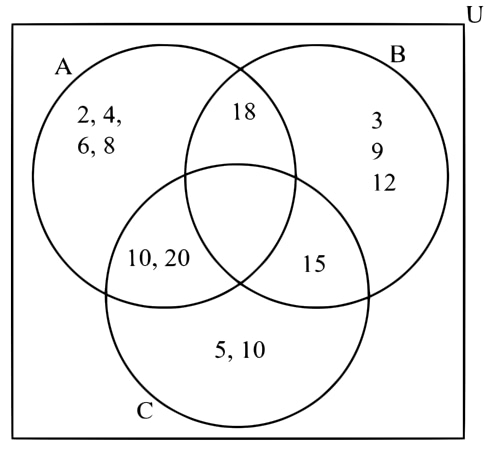
- B
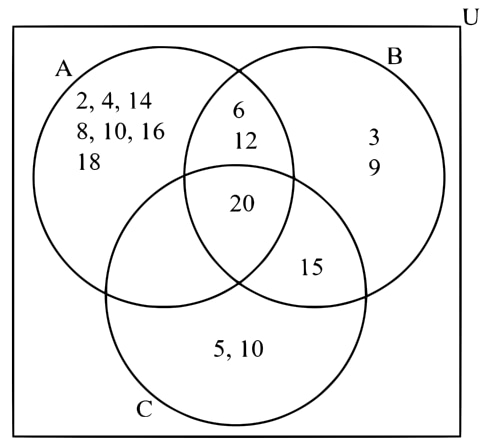
- Correct answerC
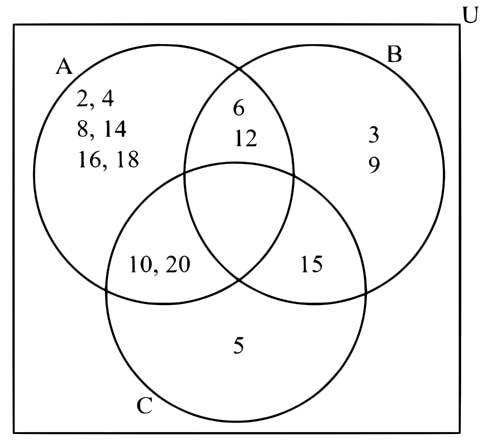
- D
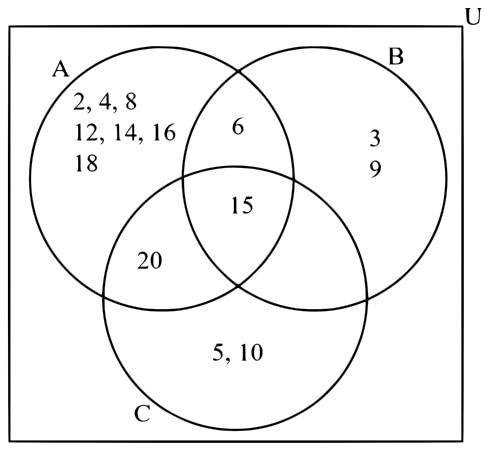
Solution
Given the sets:
A = {x : x is an even number, x $\leq$ 20} = {2, 4, 6, 8, 10, 12, 14, 16, 18, 20}
B = {x : x is a multiple of 3, x $\leq$ 15} = {3, 6, 9, 12, 15}
C = {x : x is a multiple of 5, x $\leq$ 20} = {5, 10, 15, 20}
We determine the intersections:
A $\cap$ B = {6, 12}
B $\cap$ C = {15}
A $\cap$ C = {10, 20}
A $\cap$ B $\cap$ C = $\emptyset$ (empty set, as no number is a multiple of 2, 3, and 5 simultaneously within the given ranges).
Now, calculate the elements in each region:
Only A = A - (B $\cup$ C) = {2, 4, 8, 14, 16, 18}
Only B = B - (A $\cup$ C) = {3, 9}
Only C = C - (A $\cup$ B) = {5}
A $\cap$ B (excluding C) = {6, 12}
B $\cap$ C (excluding A) = {15}
A $\cap$ C (excluding B) = {10, 20}
A $\cap$ B $\cap$ C = $\emptyset$
Comparing these sets with the provided options, the third image (option cPh4o) correctly displays these elements in their respective regions.
Answer:
Hence, the correct answer is option: 'C'.