Q92 / 120 · VITEEE 2015 · Physics
Two points masses, $m$ each carrying charges $-q$ and $+q$ are attached to the ends of a massless rigid non-conducting wire of length ' $L$ '. When this arrangement is placed in a uniform electric field, then it deflects through an angle $i$. The minimum time needed by rod to align itself along the field is
- A$2 \pi \sqrt{\frac{m L}{q E}}$
- Correct answerB$\frac{\pi}{2} \sqrt{\frac{m L}{2 q E}}$
- C$\pi \sqrt{\frac{2 m L}{q E}}$
- D$2 \pi \sqrt{\frac{3 m L}{q E}}$
Solution
Torque when the wire is brought in a uniform field $\mathrm{E}$.
$\begin{array}{l}
\tau=\mathrm{qEL} \sin \theta \\
=\mathrm{qEL} \theta
\end{array} \quad[\because \theta \text { is very small }]$
Moment of inertia of rod AB about O
$\mathrm{I}=\mathrm{m}\left(\frac{\mathrm{L}}{2}\right)^{2}+\mathrm{m}\left(\frac{\mathrm{L}}{2}\right)^{2}=\frac{\mathrm{mL}^{2}}{2}$
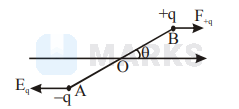
$\begin{array}{l} \tau=\mathrm{I} \alpha . \\ \therefore \quad \alpha=\frac{\tau}{\mathrm{I}}=\frac{\mathrm{qEL} \theta}{\frac{\mathrm{mL}^{2}}{2}} \\ \Rightarrow \quad \omega^{2} \theta=\frac{2 \mathrm{qEL} \theta}{\mathrm{mL}^{2}} \quad\left[\because \theta=\omega^{2} \theta\right] \\ \Rightarrow \quad \omega^{2}=\frac{2 \mathrm{q} \mathrm{E}}{\mathrm{mL}} \end{array}$ Time period of the wire $\mathrm{T}=\frac{2 \pi}{\omega}=2 \pi \sqrt{\frac{\mathrm{mL}}{2 \mathrm{q} \mathrm{E}}}$ The rod will become parallel to the field in time $\frac{T}{4}$. $\therefore \quad \mathrm{t}=\frac{\mathrm{T}}{4}=\frac{\pi}{2} \sqrt{\frac{\mathrm{mL}}{2 \mathrm{q} \mathrm{E}}}$
$\begin{array}{l} \tau=\mathrm{I} \alpha . \\ \therefore \quad \alpha=\frac{\tau}{\mathrm{I}}=\frac{\mathrm{qEL} \theta}{\frac{\mathrm{mL}^{2}}{2}} \\ \Rightarrow \quad \omega^{2} \theta=\frac{2 \mathrm{qEL} \theta}{\mathrm{mL}^{2}} \quad\left[\because \theta=\omega^{2} \theta\right] \\ \Rightarrow \quad \omega^{2}=\frac{2 \mathrm{q} \mathrm{E}}{\mathrm{mL}} \end{array}$ Time period of the wire $\mathrm{T}=\frac{2 \pi}{\omega}=2 \pi \sqrt{\frac{\mathrm{mL}}{2 \mathrm{q} \mathrm{E}}}$ The rod will become parallel to the field in time $\frac{T}{4}$. $\therefore \quad \mathrm{t}=\frac{\mathrm{T}}{4}=\frac{\pi}{2} \sqrt{\frac{\mathrm{mL}}{2 \mathrm{q} \mathrm{E}}}$
Hence, the correct answer is option: 'B'.