Q82 / 120 · VITEEE 2006 · Physics
Two point charges $4 \mu \mathrm{C}$ and $-2 \mu \mathrm{C}$ are separated by a distance of $1 \mathrm{~m}$ in air. Then the distance of the point on the line joining the charges, where the resultant electric field is zero, is (in metre)
- Correct answerA$0.58$
- B$0.75$
- C$0.67$
- D$0.81$
Solution
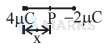
Let the point $\mathrm{P}$ where resultant field is zero be $x \mathrm{~m}$ from $4 \mu \mathrm{C}$ charge and $(1-\mathrm{x}) \mathrm{m}$ distance apart from $-2 \mu \mathrm{C}$ charge. Since field is zero at this point then, $\begin{array}{l} \overrightarrow{\mathrm{E}}=\overrightarrow{\mathrm{E}}_{1}+\overrightarrow{\mathrm{E}}_{2}=0 \\ \Rightarrow|\overrightarrow{\mathrm{E}}|=\frac{1}{4 \pi \epsilon_{0}} \frac{\mathrm{q}_{1}}{\mathrm{r}_{1}^{2}}+\frac{1}{4 \pi \epsilon_{0}} \frac{\mathrm{q}_{2}}{\mathrm{r}_{2}^{2}} \\ \Rightarrow 0=\frac{1}{4 \pi \epsilon_{0}}\left[\frac{4 \mu \mathrm{C}}{\mathrm{x}^{2}}+\frac{(-2 \mu \mathrm{C})}{(1-\mathrm{x})^{2}}\right] \\ \Rightarrow \frac{4 \mu \mathrm{C}}{\mathrm{x}^{2}}=\frac{2 \mu \mathrm{C}}{(1-\mathrm{x})^{2}} \Rightarrow \frac{2}{\mathrm{x}^{2}}=\frac{1}{(1-\mathrm{x})^{2}} \\ \Rightarrow 2(1-\mathrm{x})^{2}=\mathrm{x}^{2} \end{array}$ Taking root $\sqrt{2}(1-x)=x$ $\begin{array}{l} \Rightarrow 1.414(1-x)=x \Rightarrow 1.414-1.414 x=x \\ \Rightarrow 1.414=(1+1.414) x \Rightarrow x=\frac{1.414}{2.414} \\ \Rightarrow x=0.58 \mathrm{~m} \end{array}$
Hence, the correct answer is option: 'A'.