Q194 / 200 · MHT CET - Medical 2026 (21 April Shift 2) · Physics
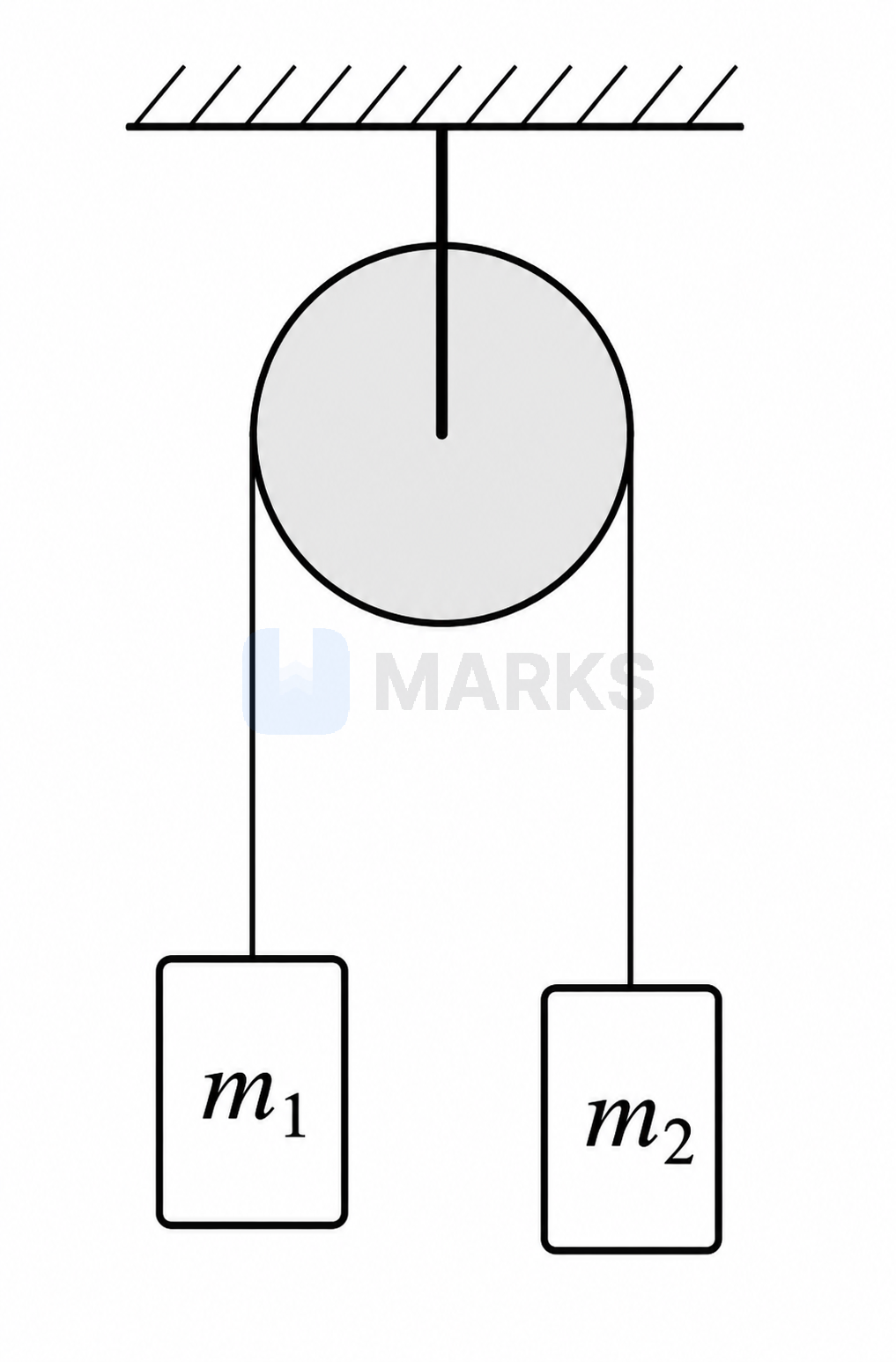
Two masses '$m_1$' and '$m_2$' ($m_1 > m_2$) tied to a massless, inextensible string are hanging over a light frictionless pulley as shown. When the system is free to move, the acceleration of the masses is $g/4$. The masses '$m_1$' and '$m_2$' are related as [$g$ = acceleration due to gravity]
- A$5\,m_1 = 4\,m_2$
- B$5\,m_1 = 3\,m_2$
- C$4\,m_1 = 5\,m_2$
- Correct answerD$3\,m_1 = 5\,m_2$
Solution
For an Atwood machine, the acceleration $a$ of the masses is given by:
$a = \dfrac{|m_1 - m_2|}{m_1 + m_2}g$
Given that the acceleration $a = \dfrac{g}{4}$, we can write:
$\dfrac{|m_1 - m_2|}{m_1 + m_2}g = \dfrac{g}{4}$
Canceling $g$ from both sides and cross-multiplying:
$4|m_1 - m_2| = m_1 + m_2$
Since $m_1 > m_2$:
$4(m_1 - m_2) = m_1 + m_2$
$4m_1 - 4m_2 = m_1 + m_2$
$3m_1 = 5m_2$
Answer: $3\,m_1 = 5\,m_2$
Hence, the correct answer is option: 'D'.