Q127 / 160 · JIPMER 2013 · Physics
Two equal negative charges $-q$ are fixed at the point $(0, a)$ and $(0,-a)$ on the $y$-axis. A positive charge $Q$ is released from rest at the point $(2 a, 0)$ on the $x$-axis. The charge will
- Aexecute SHM about the origin
- Bmove to the origin and remain at rest
- Cmove to infinity
- Correct answerDexecute oscillatory but not SHM
Solution
Component of force on charge of $+Q$ at $P$, along $x$-axis,
$\begin{aligned} F_x & =\frac{2 Q q}{4 \pi \varepsilon_0\left(a^2+x^2\right)} \times \frac{x}{\sqrt{a^2+x^2}} \\ & =\frac{2 Q q x}{4 \pi \varepsilon_0\left(a^2+x^2\right)} \times \frac{x}{\sqrt{a^2+x^2}} \\ & =\frac{2 Q q x}{4 \pi \varepsilon_0\left(a^2+x^2\right)^{3 / 2}}\end{aligned}$
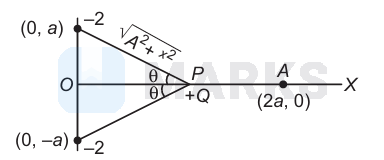 Which is not directly proportional to $x$. So, motion is oscillatory but not SHM.
Hence, the correct answer is option: 'D'.