Q143 / 180 · KCET 2015 · Physics
Three resistances \( 2 \Omega, 3 \Omega \) and \( 4 \Omega \) are connected in parallel. The ratio of currents passing
through them when a potential difference is applied across its ends will be
through them when a potential difference is applied across its ends will be
- A\( 6: 3: 2 \)
- Correct answerB\( 6: 4: 3 \)
- C\( 5: 4: 3 \)
- D\( 4: 3: 2 \)
Solution
According to Ohm's law, we have \( V=\mathbb{R} \).
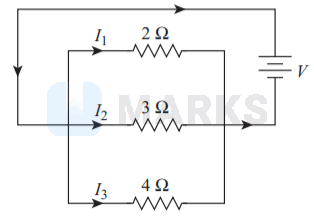
Since the resistors are connected in parallel, therefore, \( V \) is constant. So,
\[ \begin{array}{l} I R=\text { constant } \Rightarrow I \propto \frac{1}{R} \\ \Rightarrow I_{1} \propto \frac{1}{2 \Omega}, I_{2} \propto \frac{1}{3 \Omega^{\prime}} I_{3} \propto \frac{1}{4 \Omega} \\ \Rightarrow I_{1}: I_{2}: I_{3}=6: 4: 3 \end{array} \]
Hence, the correct answer is option: 'B'.