Q146 / 180 · AIIMS 2003 · Physics
The maximum distance upto which TV transmission from a TV tower of height $h$ can be received is proportional to
- Correct answerA$h^{1 / 2}$
- B$h$
- C$h^3$
- D$h^2$.
Solution
If the height of the antenna is $h$, then the maximum distance upto which the TV transmission for a TV tower can be received is proportional to $h^{1 / 2}$.
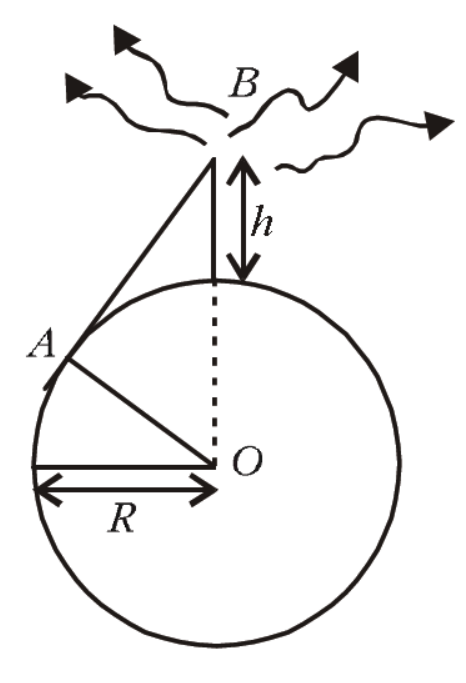
Suppose that the height of the TV antena be $h$ and the radius of the earth be $R$ and $R>>h$. Let $A$ be a receiving station. In the limit $h< < R$, we can assume that $B A$ is a tangent to the surface of the earth. Then $\angle B A O=90^{\circ}$ and so $$ B O^2=A B^2+A O^2 \Rightarrow(R+h)^2=A B^2+R^2 $$ $$ \Rightarrow \quad A B^2=R^2+h^2+2 R h-R^2=2 R h+h^2 $$ as $h< < R$ we neglect $h^2$ and so $$ \begin{aligned} & A B^2=2 R h \Rightarrow A B=\sqrt{2 R h} \\ \therefore \quad & A B \propto h^{1 / 2} . \end{aligned} $$
Suppose that the height of the TV antena be $h$ and the radius of the earth be $R$ and $R>>h$. Let $A$ be a receiving station. In the limit $h< < R$, we can assume that $B A$ is a tangent to the surface of the earth. Then $\angle B A O=90^{\circ}$ and so $$ B O^2=A B^2+A O^2 \Rightarrow(R+h)^2=A B^2+R^2 $$ $$ \Rightarrow \quad A B^2=R^2+h^2+2 R h-R^2=2 R h+h^2 $$ as $h< < R$ we neglect $h^2$ and so $$ \begin{aligned} & A B^2=2 R h \Rightarrow A B=\sqrt{2 R h} \\ \therefore \quad & A B \propto h^{1 / 2} . \end{aligned} $$
Hence, the correct answer is option: 'A'.