Q87 / 200 · NEET 2006 · Chemistry
The major organic product in the reaction,
$\mathrm{CH}_3-\mathrm{O}-\mathrm{CH}\left(\mathrm{CH}_3\right)_2+\mathrm{HI} \rightarrow$ products is:
- Correct answerA$\mathrm{CH}_3 \mathrm{I}+\left(\mathrm{CH}_3\right)_2 \mathrm{CHOH}$
- B$\mathrm{CH}_3 \mathrm{OH}+\left(\mathrm{CH}_3\right)_2 \mathrm{CHI}$
- C$\mathrm{ICH}_2 \mathrm{OCH}\left(\mathrm{CH}_3\right)_2$
- D\(\begin{array}{c}\mathrm{CH}_3 \mathrm{OC}\left(\mathrm{CH}_3\right)_2 \\ | \\ \mathrm{I} \end{array}\)
Solution
In the case of an unsymmetrical ether, the alkyl halide is always formed from the smaller alkyl group. This happens because the $\mathrm{I}^{-}$ ion being larger in sizc approaches the smaller alkyl group to avoid steric hindrance.
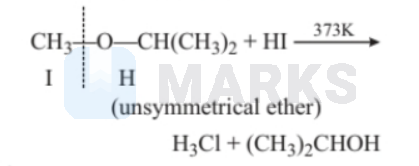
Caution $H I$ is an acid and when it is hot and concentrated it means we are having an excess of $\mathrm{HI}$. Iodide ion produced from $\mathrm{HI}$ in this reaction will act as a nucleophile.
Caution $H I$ is an acid and when it is hot and concentrated it means we are having an excess of $\mathrm{HI}$. Iodide ion produced from $\mathrm{HI}$ in this reaction will act as a nucleophile.
Hence, the correct answer is option: 'A'.