Q103 / 180 · KCET 2019 · Mathematics
The interval in which the function \( f(x)=x^{3}-6 x^{2}+9 x+10 \) is increasing in
- Correct answerA\((-\infty, 1] \cup[3, \infty) \)
- B\((-\infty,-1] \cup[3, \infty) \)
- C\( (-\infty, 1) \cup(3, \infty) \)
- D\( [1,3] \)
Solution
\(\begin{aligned}
&f(x)=x^{3}-6 x^{2}+9 x+10 \\
&f^{\prime}(x)=3 x^{2}-12 x+9 \\
&f^{\prime}(x)=3\left(x^{2}-4 x+3\right) \\
&f^{\prime}(x)=3(x-1)(x-3)
\end{aligned}\)
For \(f(x)\) to be inereasing, we must have
\(\begin{aligned}
& F^{\prime}(x) > 0 \\
\Rightarrow & 3(x-1)(x-3) > 0 \\
\Rightarrow &(x-1)(x-3) > 0 \\
\Rightarrow & x < 1 \text { or } x > 3 \\
\Rightarrow & x \in(-\infty, 1) \cup(3, \infty) \\
& \text { SO, } F(x) \text { is increasing on } x \in(-\infty, 1) \cup(3, \infty) .
\end{aligned}\)
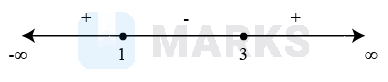 For \(f(x)\) to be decrecsing, we must hare
\(F^{\prime}(x) < 0\)
\(\begin{aligned}
&\Rightarrow 3(x-1)(x-3) < 0 \\
&\Rightarrow(x-1)(x-3) < 0 \\
&\Rightarrow 1 < x < 3 \\
&\Rightarrow x \in(1,3)
\end{aligned}\)
so, \(f(x)\) is decreasing on \(x \in(1,3)\).
For \(f(x)\) to be decrecsing, we must hare
\(F^{\prime}(x) < 0\)
\(\begin{aligned}
&\Rightarrow 3(x-1)(x-3) < 0 \\
&\Rightarrow(x-1)(x-3) < 0 \\
&\Rightarrow 1 < x < 3 \\
&\Rightarrow x \in(1,3)
\end{aligned}\)
so, \(f(x)\) is decreasing on \(x \in(1,3)\).
Hence, the correct answer is option: 'A'.