Q97 / 180 · KCET 2024 · Mathematics
If $f(x)=x e^{x(1-x)}$, then $f(x)$ is
- Aincreasing in $R$
- Bdecreasing in $R$
- Cdecreasing in $\left[-\frac{1}{2}, 1\right]$
- Correct answerDincreasing in $\left[-\frac{1}{2}, 1\right]$
Solution
Given, $f(x)=x e^{x(1-x)}$
$f^{\prime}(x)=e^{x(1-x)}+x e^{x(1-x)}(1-2 x)$
$=e^{x(1-x)}(1+x(1-2 x))$
$=-e^{x(1-x)}\left(2 x^2-x-1\right)$
$=-e^{x(1-x)}\left(2 x^2-2 x+x-1\right)$
$=-e^{x(1-x)}(x-1)(2 x+1)$
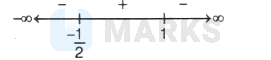
So, $f(x)$ is increasing when $f^{\prime}(x) \geq 0$ and decreasing when $f^{\prime}(x) \leq 0$. Hence, $f$ is increasing in $\left[\frac{-1}{2}, 1\right]$.
So, $f(x)$ is increasing when $f^{\prime}(x) \geq 0$ and decreasing when $f^{\prime}(x) \leq 0$. Hence, $f$ is increasing in $\left[\frac{-1}{2}, 1\right]$.
Hence, the correct answer is option: 'D'.