Q33 / 90 · KVPY 2016 (SB/SX) · Mathematics
The graph of the function $\mathrm{f}(\mathrm{x})=\mathrm{x}+\frac{1}{8} \sin (2 \pi \mathrm{x}), 0 \leq \mathrm{x} \leq 1$ is shown below. Define $f_{1}(x)=f(x), f_{n+1}(x)=f\left(f_{n}(x)\right)$, for $n \geq 1$
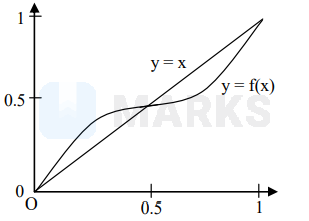
Which of the following statements are true?
I. There are infinitely many $x \in[0,1]$ for which $\lim _{n \rightarrow \infty} f_{n}(x)=0$
II. There are infinitely many $\mathrm{x} \in[0,1]$ for which $\lim _{\mathrm{n} \rightarrow \infty} \mathrm{f}_{\mathrm{n}}(\mathrm{x})=\frac{1}{2}$
III. There are infinitely many $x \in[0,1]$ for which $\lim _{n \rightarrow \infty} f_{n}(x)=1$
IV. There are infinitely many $x \in[0,1]$ for which $\lim _{n \rightarrow \infty} f_{n}(x)$ does not exist
Which of the following statements are true? I. There are infinitely many $x \in[0,1]$ for which $\lim _{n \rightarrow \infty} f_{n}(x)=0$ II. There are infinitely many $\mathrm{x} \in[0,1]$ for which $\lim _{\mathrm{n} \rightarrow \infty} \mathrm{f}_{\mathrm{n}}(\mathrm{x})=\frac{1}{2}$ III. There are infinitely many $x \in[0,1]$ for which $\lim _{n \rightarrow \infty} f_{n}(x)=1$ IV. There are infinitely many $x \in[0,1]$ for which $\lim _{n \rightarrow \infty} f_{n}(x)$ does not exist
- AI and III only
- Correct answerBII only
- CI, II, III only
- DI, II, III and IV
Solution
$\lim _{n \rightarrow \infty} f_{n}(x)=f(f(f(\ldots \ldots \ldots \infty$ times $(x))$
Now for $\mathrm{x}_{1} \in\left(0, \frac{1}{2}\right)$
$\mathrm{f}\left(\mathrm{x}_{1}\right)>\mathrm{x}_{1}$ as $\mathrm{f}(\mathrm{x})$ is concave - downward Thus $\mathrm{f}_{\mathrm{n}} \rightarrow \frac{1}{2}$ as $\mathrm{n} \rightarrow \infty$
Similarly for $\mathrm{x}_{1} \in\left(\frac{1}{2}, 1\right)$
$\mathrm{f}\left(\mathrm{x}_{1}\right) < \mathrm{x}_{1}$ as $\mathrm{f}(\mathrm{x})$ is concave upward Thus $\mathrm{f}_{\mathrm{n}} \rightarrow \frac{1}{2}$ as $\mathrm{n} \rightarrow \infty$
Hence, the correct answer is option: 'B'.