Q75 / 270 · NDA 2026 (Phase 1) · General Ability
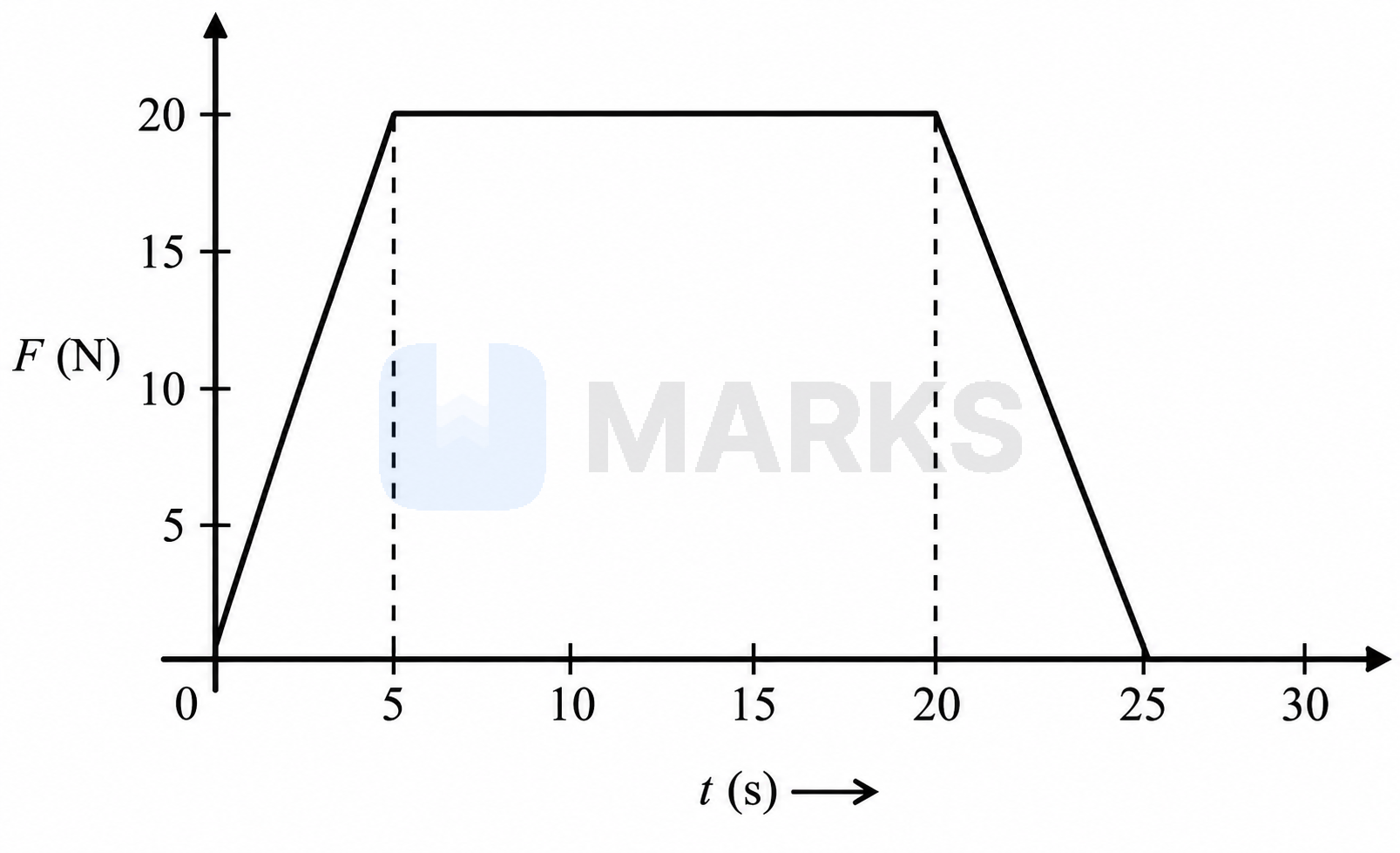
The force-time $(F\text{-}t)$ graph of a $10\,\text{kg}$ moving object is shown below:
What is the final speed of the object?
What is the final speed of the object?
- A$0$
- B$15\,\text{m/s}$
- C$30\,\text{m/s}$
- Correct answerD$40\,\text{m/s}$
Solution
The area under the force-time ($F$-$t$) graph gives the impulse, which is equal to the change in momentum of the object.
$\text{Impulse} = \text{Area of the trapezium}$
$\text{Area} = \dfrac{1}{2} \times (\text{sum of parallel sides}) \times \text{height}$
$\text{Area} = \dfrac{1}{2} \times (25 + 15) \times 20$
$\text{Area} = \dfrac{1}{2} \times 40 \times 20 = 400 \, \text{N}\cdot\text{s}$
By the impulse-momentum theorem:
$\Delta p = m(v - u)$
Assuming the object starts from rest ($u = 0$):
$400 = 10 \times (v - 0)$
$v = 40 \, \text{m/s}$
Answer: $40\,\text{m/s}$
Hence, the correct answer is option: 'D'.