Q74 / 270 · NDA 2026 (Phase 1) · General Ability
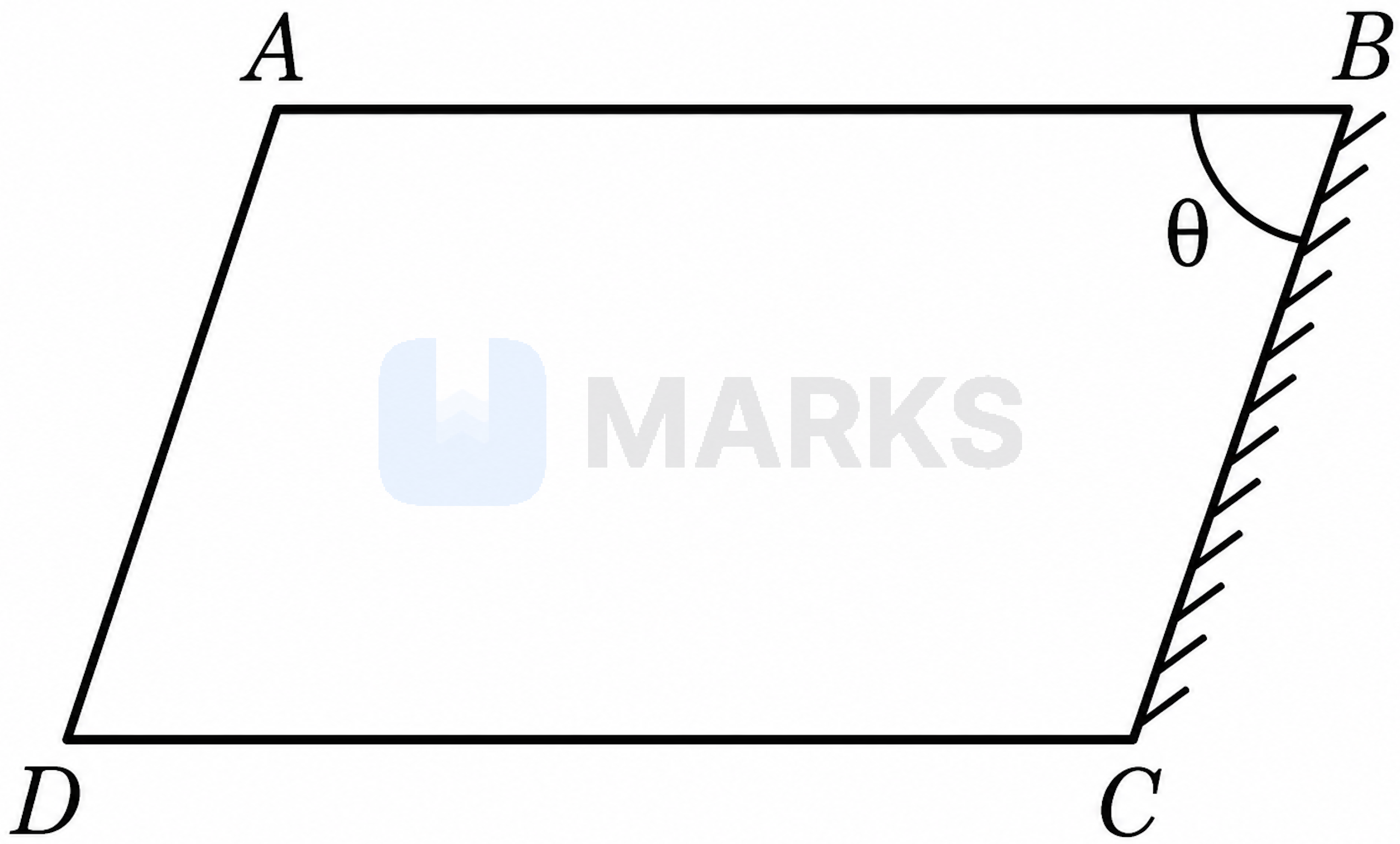
A glass slab of refractive index $1.5$ is cut in the shape of a parallelepiped $ABCD$ as shown in the figure. Surface $BC$ is polished to form a perfect reflector. Light is incident at surface $AB$ from inside at an angle $\pi/3$. Which one of the following is the correct angle $ABC$ $(\theta)$ such that the reflected light retraces its path?
- Correct answerA$\pi/6$
- B$\pi/3$
- C$\pi/4$
- D$5\pi/12$
Solution
For the reflected light to retrace its path, it must strike the polished surface $BC$ normally (perpendicularly). This means the angle between the reflected ray and surface $BC$ must be $90^{\circ}$.
Assuming the given angle $\pi/3$ ($60^{\circ}$) is the angle the incident ray makes with the surface $AB$, by the law of reflection, the reflected ray will also make an angle of $60^{\circ}$ with the surface $AB$.
Consider the triangle formed by the point of incidence on $AB$, the point of normal incidence on $BC$, and the vertex $B$. The sum of the internal angles in this triangle must be $180^{\circ}$.
The angle between the reflected ray and surface $AB$ is $60^{\circ}$.
The angle between the reflected ray and surface $BC$ is $90^{\circ}$.
Therefore, the angle $\theta$ (angle $ABC$) is:
$\theta = 180^{\circ} - (90^{\circ} + 60^{\circ}) = 30^{\circ}$
Converting $30^{\circ}$ to radians, we get $\theta = \pi/6$.
Hence, the correct answer is option: 'A'.