Q6 / 75 · JEE Main 2026 (23 January Shift 1) · Chemistry
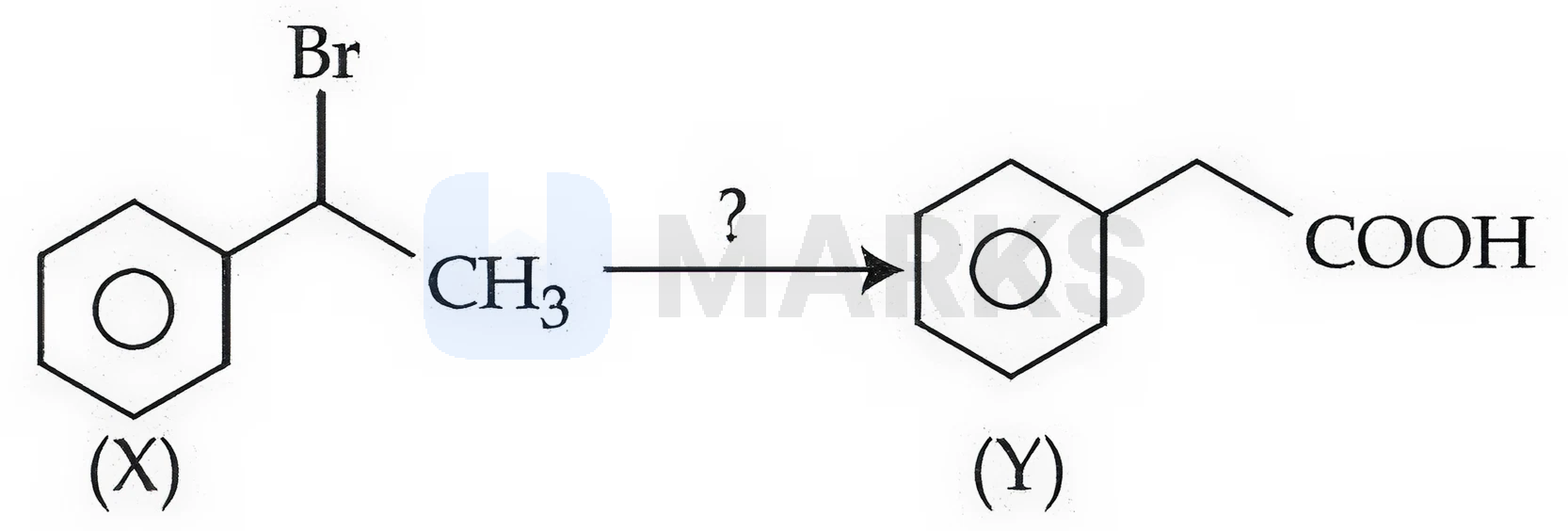
The correct sequence of reagents for the above conversion of X to Y is :
The correct sequence of reagents for the above conversion of X to Y is :
- A(i) \(\mathrm{NaOH}(\mathrm{aq})\); $\ \ \ $ (ii) Jones reagent; (iii) $\ \ \ $ \(\mathrm{H}_3 \mathrm{O}^{+}\)
- B(i) \(\mathrm{B}_2 \mathrm{H}_6 / \mathrm{H}_2 \mathrm{O}_2\); $\ \ \ $ (ii) NaOEt; $\ \ \ $ (iii) Jones reagent
- C(i) Jones reagent; $\ \ \ $ (ii) NaOEt; $\ \ \ $ (iii) \(\mathrm{Hot} \mathrm{KMnO}_4 / \mathrm{KOH}\)
- Correct answerD(i) NaOEt; $\ \ \ $ (ii) \(\mathrm{B}_2 \mathrm{H}_6 / \mathrm{H}_2 \mathrm{O}_2\); $\ \ \ $ (iii) Jones reagent
Solution
The transformation of (X) benzene with Br and CH₃ substituents to (Y) benzene with CH₂COOH requires:
First, NaOEt causes elimination of HBr to form an alkene intermediate.
Second, B₂H₆/H₂O₂ performs hydroboration-oxidation, adding hydroxyl group in anti-Markovnikov fashion to yield a primary alcohol.
Third, Jones reagent oxidizes the primary alcohol to carboxylic acid.
The sequence NaOEt → B₂H₆/H₂O₂ → Jones reagent produces the desired carboxylic acid product.
Hence, the correct answer is option: 'D'.