Q17 / 75 · JEE Main 2026 (06 April Shift 1) · Chemistry
Consider the following sequence of reactions
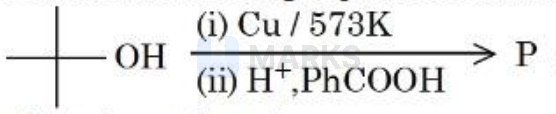
The major product P is:
The major product P is:
- A
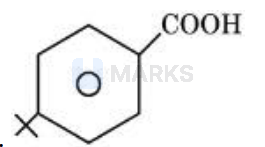
- B
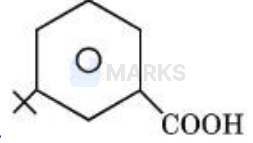
- Correct answerC
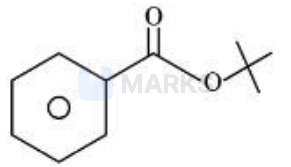
- D
Solution
Step 1: The first reagent is Cu at $573\text{ K}$. When a tertiary alcohol like tert-butyl alcohol is passed over heated copper at $573\text{ K}$, it undergoes dehydration rather than dehydrogenation to form an alkene.
$(CH_3)_3C-OH \xrightarrow{Cu / 573\text{ K}} CH_2=C(CH_3)_2 + H_2O$
The intermediate product is isobutylene (2-methylpropene).
Step 2: The second set of reagents is $H^+$ and $PhCOOH$ (benzoic acid). This is an acid-catalyzed addition of a carboxylic acid to an alkene, which is a standard method for synthesizing tert-butyl esters.
First, the alkene is protonated by the acid to form the most stable carbocation, which is the tertiary butyl carbocation:
$CH_2=C(CH_3)_2 + H^+ \rightleftharpoons (CH_3)_3C^+$
Next, the carboxylic acid acts as a nucleophile and attacks the carbocation. The oxygen atom of the benzoic acid attacks the tert-butyl carbocation, followed by deprotonation:
$PhCOOH + (CH_3)_3C^+ \rightleftharpoons Ph-CO-O^+(H)-C(CH_3)_3 \rightleftharpoons Ph-CO-O-C(CH_3)_3 + H^+$
The final major product is tert-butyl benzoate. Electrophilic aromatic substitution (Friedel-Crafts alkylation) on the benzene ring does not occur here because the $-COOH$ group is strongly deactivating, making O-alkylation (ester formation) the highly preferred pathway.
Comparing this with the given options, Option (C) represents the structure of tert-butyl benzoate.
Answer:
Hence, the correct answer is option: 'C'.