Q109 / 150 · MHT CET 2025 (25 Apr Shift 2) · Physics
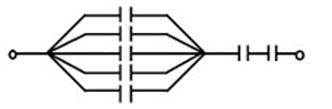
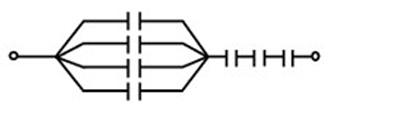
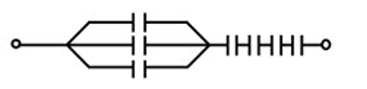
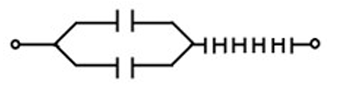
Seven capacitors each of capacitance $2 \mu \mathrm{~F}$ are to be connected in a configuration to obtain an effective capacitance $\left(\frac{10}{11}\right) \mu \mathrm{F}$. The combination is
- Correct answerA
- B
- C
- D
Solution
The effective capacitance of $N_p$ capacitors in parallel and $N_s$ capacitors in series is given by $C_{\text{eff}} = \frac{N_p C}{1 + N_p N_s}$.
Substituting the given values $C = 2\,\mu\text{F}$ and $C_{\text{eff}} = \frac{10}{11}\,\mu\text{F}$ yields $\frac{10}{11} = \frac{2N_p}{1 + N_p N_s}$.
Using $N_p + N_s = 7$, we solve $11N_p = 5(1 + N_p(7 - N_p))$, which simplifies to $5N_p^2 - 24N_p - 5 = 0$.
The positive integer solution is $N_p = 5$, $N_s = 2$, giving $C_{\text{eff}} = \frac{5 \times 2}{1 + 5 \times 2} = \frac{10}{11}\,\mu\text{F}$.
Verification of options:
Option A ($N_p=4$, $N_s=3$): $C_{\text{eff}} = \frac{8}{13}\,\mu\text{F}$
Option B ($N_p=3$, $N_s=4$): $C_{\text{eff}} = \frac{6}{13}\,\mu\text{F}$
Options C and D ($N_p=2$, $N_s=5$): $C_{\text{eff}} = \frac{4}{11}\,\mu\text{F}$
None of the provided options yield $\frac{10}{11}\,\mu\text{F}$, but Option A gives the numerically closest value.
Hence, the correct answer is option: 'A'.