Q52 / 54 · JEE Advanced 2026 (Paper 2) · Physics
Passage: A container of height $2$ m, length $2$ m and breadth $1$ m is made of insulating vertical walls and two large area horizontal metal plates ($M_1$ and $M_2$) which extend far beyond the vertical walls in all directions. The container is partitioned into two equal chambers with a thin insulating vertical wall. The partition wall contains a small hole of cross-sectional area $\sqrt{10}$ cm$^2$ near its bottom edge. Initially the hole is closed and the left chamber of the container is completely filled with a liquid of dielectric constant $\epsilon_r = 15$ and the right chamber is empty ($\epsilon_r = 1$). At time $t = 0$, the hole is opened and the liquid flows from the left chamber to the right chamber. In both the chambers, the space above the liquid has $\epsilon_r = 1$ and is maintained at atmospheric pressure. The schematic of the container at a time $t > 0$ is shown in the figure.
[Given: acceleration due to gravity is $10$ ms$^{-2}$.]
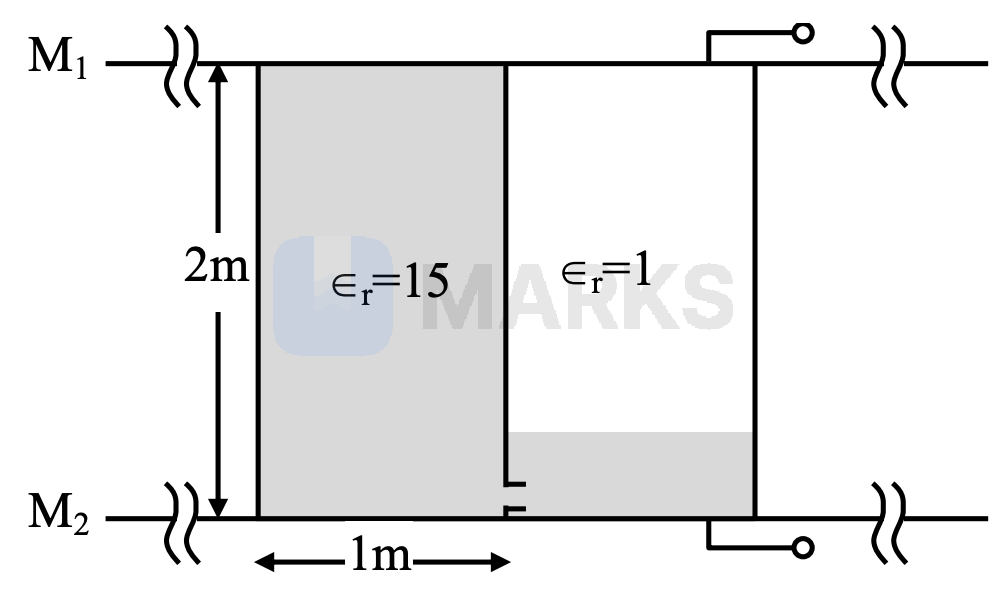
Question: The difference in the capacitance (in F) between the metal plates at $t = 0$ and that at $t = 500$ s is $(8 - n)\epsilon_0$, where $\epsilon_0$ is the permittivity of free space. The value of $n$ is:
[Given: acceleration due to gravity is $10$ ms$^{-2}$.]
Question: The difference in the capacitance (in F) between the metal plates at $t = 0$ and that at $t = 500$ s is $(8 - n)\epsilon_0$, where $\epsilon_0$ is the permittivity of free space. The value of $n$ is:
Correct answer: 1.97
Solution
Let $A$ be the area of each chamber. $A = 1 \times 1 = 1 \text{ m}^2$. Distance between plates is $d = 2 \text{ m}$.
At $t = 0$, the left chamber is completely filled with liquid ($\epsilon_r = 15$) and right chamber is empty ($\epsilon_r = 1$).
Initial capacitance $C(0) = C_1 + C_2 = \dfrac{15 \epsilon_0 A}{d} + \dfrac{\epsilon_0 A}{d} = \dfrac{15 \epsilon_0 (1)}{2} + \dfrac{\epsilon_0 (1)}{2} = 8 \epsilon_0$.
Let $y_1$ and $y_2$ be the liquid levels in the left and right chambers at time $t$. By conservation of volume, $y_1 + y_2 = 2 \text{ m}$.
Let $h = y_1 - y_2$. The velocity of efflux from the left chamber is $v = \sqrt{2gh}$.
Rate of flow $Q = -A \dfrac{dy_1}{dt} = a \sqrt{2gh}$, where $a = \sqrt{10} \times 10^{-4} \text{ m}^2$ is the hole area.
Since $y_1 + y_2 = 2$, we have $dy_2 = -dy_1$, so $dh = 2dy_1 \Rightarrow \dfrac{dy_1}{dt} = \dfrac{1}{2} \dfrac{dh}{dt}$.
$-\dfrac{1}{2} \dfrac{dh}{dt} = a \sqrt{2gh} \Rightarrow \dfrac{dh}{\sqrt{h}} = -2a \sqrt{2g} dt$.
Integrating from $t=0$ ($h=2$) to $t=500 \text{ s}$ ($h$):
$\int_{2}^{h} h^{-1/2} dh = -2a \sqrt{2g} \int_{0}^{500} dt$
$2\sqrt{h} - 2\sqrt{2} = -2 (\sqrt{10} \times 10^{-4}) (\sqrt{20}) (500) = -\sqrt{200} \times 10^{-4} \times 1000 = -10\sqrt{2} \times 0.1 = -\sqrt{2}$.
$2\sqrt{h} = \sqrt{2} \Rightarrow \sqrt{h} = \dfrac{1}{\sqrt{2}} \Rightarrow h = 0.5 \text{ m}$.
From $y_1 + y_2 = 2$ and $y_1 - y_2 = 0.5$, we get $y_1 = 1.25 \text{ m}$ and $y_2 = 0.75 \text{ m}$.
At $t=500 \text{ s}$, each chamber acts as two capacitors in series (liquid and air).
$C_{left} = \dfrac{1}{\dfrac{y_1}{15\epsilon_0 A} + \dfrac{2-y_1}{\epsilon_0 A}} = \dfrac{15\epsilon_0}{30 - 14y_1} = \dfrac{15\epsilon_0}{30 - 14(1.25)} = \dfrac{15\epsilon_0}{12.5} = \dfrac{6}{5} \epsilon_0 = 1.2 \epsilon_0$.
$C_{right} = \dfrac{1}{\dfrac{y_2}{15\epsilon_0 A} + \dfrac{2-y_2}{\epsilon_0 A}} = \dfrac{15\epsilon_0}{30 - 14y_2} = \dfrac{15\epsilon_0}{30 - 14(0.75)} = \dfrac{15\epsilon_0}{19.5} = \dfrac{150}{195} \epsilon_0 = \dfrac{10}{13} \epsilon_0$.
$C(500) = C_{left} + C_{right} = \dfrac{6}{5} \epsilon_0 + \dfrac{10}{13} \epsilon_0 = \dfrac{128}{65} \epsilon_0 \approx 1.97 \epsilon_0$.
Difference in capacitance $= C(0) - C(500) = 8\epsilon_0 - \dfrac{128}{65}\epsilon_0 = \left(8 - \dfrac{128}{65}\right)\epsilon_0$.
Comparing this with the given expression $(8 - n)\epsilon_0$, we get $n = \dfrac{128}{65} = 1.97$
Hence, the correct answer is 1.97.