Q89 / 200 · NEET 2006 · Chemistry
Nucleophilic addition reaction will be most favoured in:
- Correct answerA$\mathrm{CH}_3 \mathrm{CHO}$
- B\(\begin{array}{c}\mathrm{CH}_3-\mathrm{CH}_2-\mathrm{CH}_2 \mathrm{C}-\mathrm{CH}_3 \\ \qquad \qquad \quad || \\ \qquad \qquad \quad \mathrm{O} \end{array}\)
- C$\left(\mathrm{CH}_3\right)_2 \mathrm{C}=\mathrm{O}$
- D$\mathrm{CH}_3 \mathrm{CH}_2 \mathrm{CHO}$
Solution
In aldehydes, $-\mathrm{C}=\mathrm{O}$ has the presence of at least one alkyl group except formaldehyde which has the $+\mathrm{I}$ effect and which decreases the positive charge of carbon, thereby making the attack of nucleophiles difficult. The nucleophilic attack becomes more difficult in ketones having a minimum of two alkyl groups. Hence, by attachment of the alkyl groups (due to the $+\mathrm{I}$ effect), the rate of nucleophilic addition decreases. Order of nucleophilic addition.
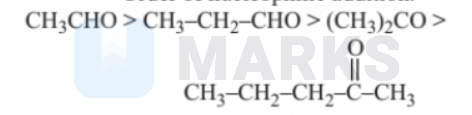
Related Theory The carbonyl compounds undergo a nucleophilic addition reaction because oxygen is more electronegative than carbon. As such, it withdraws the shared pi electron pair towards itself and gets a partial negative charge; therefore, carbon gets a partial positive charge and becomes susceptible to a nucleophilic attack.
Related Theory The carbonyl compounds undergo a nucleophilic addition reaction because oxygen is more electronegative than carbon. As such, it withdraws the shared pi electron pair towards itself and gets a partial negative charge; therefore, carbon gets a partial positive charge and becomes susceptible to a nucleophilic attack.
Hence, the correct answer is option: 'A'.