Q37 / 120 · JEE Advanced 2006 · Chemistry
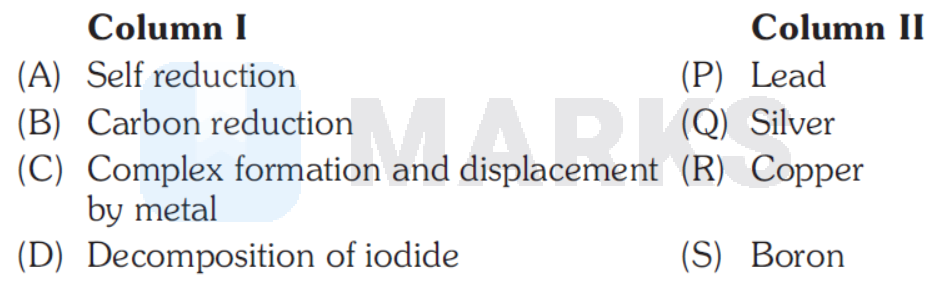
Match the extraction processes listed in column I with metals listed in column II.
- A(A) P,S, (B) R, (C) P,Q, (D) P,S
- B(A) Q,S, (B) R, (C) S, (D) S
- C(A) P,R, (B) P, R, (C) Q, (D) R
- Correct answerD(A) P,R, (B) P, (C) Q, (D) S
Solution
Column I
Column II
(A) Self reduction $\left[\begin{array}{c}P \text { - Lead } \\ R \text { - Copper }\end{array}\right]$
$$
\begin{aligned}
& \text { i.e., } A \rightleftarrows P \text { and } R \\
& \text { In lead metal } \\
& \qquad\left\{\begin{array}{c}
2 \mathrm{PbS}+3 \mathrm{O}_2 \longrightarrow 2 \mathrm{PbO}+2 \mathrm{SO}_2 \\
2 \mathrm{PbO}+\mathrm{PbS} \longrightarrow 3 \mathrm{~Pb}+\mathrm{SO}_2
\end{array}\right.
\end{aligned}
$$
(self reduction)
In copper metal
$$
\begin{aligned}
& 2 \mathrm{Cu}_2 \mathrm{~S}+3 \mathrm{O}_2 \longrightarrow 2 \mathrm{Cu}_2 \mathrm{O}+2 \mathrm{SO}_2 \\
& \mathrm{Cu}_2 \mathrm{~S}+2 \mathrm{Cu}_2 \mathrm{O} \longrightarrow 6 \mathrm{Cu}+\mathrm{SO}_2
\end{aligned}
$$
(self reduction)
(B) Carbon reduction $P$-lead
$$
\begin{aligned}
& \text { i.e., } \mathrm{B}-\mathrm{P} \\
& \text { In lead metal } \\
& \qquad \mathrm{PbO}+\mathrm{C} \longrightarrow \mathrm{Pb}+\mathrm{CO} \\
& \mathrm{PbO}+\mathrm{CO} \longrightarrow \mathrm{Pb}+\mathrm{CO}_2
\end{aligned}
$$
Carbon reduction process is used for the reduction of oxides of electropositive metals like $\mathrm{Fe}, \mathrm{Pb}$ etc. This reduction is carried out with coal or coke on strongly heating.
(C) Complex formation and displacement by metal.
i.e., $C-Q$ (silver)
In silver metal
Argentite mineral of $\mathrm{Ag}\left(\mathrm{Ag}_2 \mathrm{~S}\right)$ is treated with $0.7 \% \mathrm{NaCN}$ solution in presence of air, therefore firstly sodium argento cyanide complex is formed which on heating with zinc metal, therefore by displacement silver is isolated.
$$
\begin{aligned}
& \mathrm{Ag}_2 \mathrm{~S}+4 \mathrm{NaCN} \longrightarrow 2 \mathrm{Na}\left[\mathrm{Ag}(\mathrm{CN})_2\right]+\mathrm{Na}_2 \mathrm{~S} \\
& 2 \mathrm{Na}\left[\mathrm{Ag}(\mathrm{CN})_2\right]+\mathrm{Zn} \longrightarrow \mathrm{Na}\left[\mathrm{Zn}(\mathrm{CN})_4\right]+\underset{\text { Soluble }}{2 \mathrm{Ag}} \downarrow
\end{aligned}
$$
(D) Decomposition of iodide-(S) Boron
$$
\text { i.e., }(D)-(S)
$$
By decomposition of iodide boron metal is isolated.
Hence, the correct answer is option: 'D'.