Q25 / 54 · JEE Advanced 2019 (Paper 1) · Mathematics
Let be given by
Then which of the following options is/are correct?
Then which of the following options is/are correct?
- Correct answerAis NOT differentiable at
- Bis increasing on
- Correct answerCis onto
- Correct answerDhas a local maximum at
Solution
As given
Hence is continuous everywhere.
Now, and
Hence, range of is
Consider
Option
For which takes both positive and negative values.
Hence, is non-monotonic for
Option
Now, and
Given of in 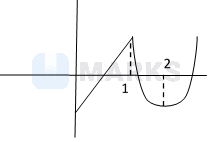
is maxima for -----Option
and is not differential at
Option
Hence, range of f
Hence, the correct answer is options: 'A', 'C', 'D'.