Q31 / 48 · JEE Advanced 2025 (Paper 1) · Mathematics
Let $\mathbb{R}$ denote the set of all real numbers. For a real number $x$, let $[x]$ denote the greatest integer less than or equal to $x$. Let $n$ denote a natural number.
Match each entry in List-I to the correct entry in List-II and choose the correct option.
LIST - I LIST - II (P) The minimum value of $n$ for which the function $f(x)=\left[\frac{10 x^3-45 x^2+60 x+35}{n}\right]$ is continuous on the interval $[1,2]$,is (1) 8 (Q) The minimum value of $n$ for which $g(x)=\left(2 n^2-13 n-15\right)\left(x^3+3 x\right),x \in \mathbb{R}$,is an increasing function on $\mathbb{R}$,is (2) 9 (R) The smallest natural number $n$ which is greater than 5,such that $x=3$ is a point of local minima of $h(x)=\left(x^2-9\right)^{\mathrm{n}}\left(x^2+2 x+3\right)$,is (3) 5 (S) Number of $x_0 \in \mathbb{R}$ such that $l(x)=\sum_{k=0}^4\left(\sin |x-k|+\cos \left|x-k+\frac{1}{2}\right|\right),x \in \mathbb{R}$,is NOT differentiable at $x_0$,is (4) 6 (5) 10
| LIST - I | LIST - II | ||
|---|---|---|---|
| (P) | The minimum value of $n$ for which the function $f(x)=\left[\frac{10 x^3-45 x^2+60 x+35}{n}\right]$ is continuous on the interval $[1,2]$,is | (1) | 8 |
| (Q) | The minimum value of $n$ for which $g(x)=\left(2 n^2-13 n-15\right)\left(x^3+3 x\right),x \in \mathbb{R}$,is an increasing function on $\mathbb{R}$,is | (2) | 9 |
| (R) | The smallest natural number $n$ which is greater than 5,such that $x=3$ is a point of local minima of $h(x)=\left(x^2-9\right)^{\mathrm{n}}\left(x^2+2 x+3\right)$,is | (3) | 5 |
| (S) | Number of $x_0 \in \mathbb{R}$ such that $l(x)=\sum_{k=0}^4\left(\sin |x-k|+\cos \left|x-k+\frac{1}{2}\right|\right),x \in \mathbb{R}$,is NOT differentiable at $x_0$,is | (4) | 6 |
| (5) | 10 |
- A$(\mathrm{P}) \rightarrow(1),(\mathrm{Q}) \rightarrow(3),(\mathrm{R}) \rightarrow(2),(\mathrm{S}) \rightarrow(5)$
- Correct answerB$(\mathrm{P}) \rightarrow(2),(\mathrm{Q}) \rightarrow(1),(\mathrm{R}) \rightarrow(4),(\mathrm{S}) \rightarrow(3)$
- C$(\mathrm{P}) \rightarrow(5),(\mathrm{Q}) \rightarrow(1),(\mathrm{R}) \rightarrow(4),(\mathrm{S}) \rightarrow(3)$
- D$(\mathrm{P}) \rightarrow(2),(\mathrm{Q}) \rightarrow(3),(\mathrm{R}) \rightarrow(1),(\mathrm{S}) \rightarrow(5)$
Solution
$\begin{aligned}
& P(x)=10 x^3-45 x^2+60 x+35 \\
& P^{\prime}(x)=30(x-1)(x-2)
\end{aligned}$
$\mathrm{P}(\mathrm{x})$ decreases in $[1,2]$
$\Rightarrow$ Range of $\mathrm{P}(\mathrm{x})=[55,60]$
$f(\mathrm{x})=\left[\frac{\mathrm{P}(\mathrm{x})}{\mathrm{n}}\right] \min$ value of $\mathrm{n}=9$
(Q) For $g(x)$ to be increasing
$2 n^2-13 n-15 \geq 0$
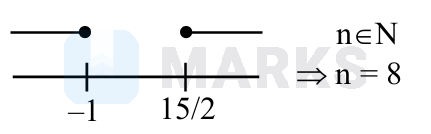
(R) $\begin{aligned} & h(x)=\left(x^2-9\right)^n\left(x^2+2 x+3\right) \\ & h^{\prime}(x)=\left(x^2-9\right)^n(2 x+2)+\left(x^2+2 x+3\right) n\left(x^2-9\right)^{n-1} \cdot 2 x \\ & =\left(x^2-9\right)^{n-1}\left[2\left(x^2-9\right)(x+1)+2 n x\left(x^2+2 x+3\right)\right] \\ & =(x+3)^{n-1}(x-3)^{n-1} \cdot q(x)\end{aligned}$ Derivative must change sign at $x=3$ $\begin{aligned} & \because \mathrm{n}-1=\text { odd } \\ & \mathrm{n}=\text { even } \\ & \mathrm{n}=6 \end{aligned}$ (S) $\cos \left|\mathrm{x}-\mathrm{k}+\frac{1}{2}\right|$ is differentiable everywhere $\Rightarrow \sin |\mathrm{x}-\mathrm{k}|$ is NOT diff. at $\mathrm{k}=0,1,2,3,4$
(R) $\begin{aligned} & h(x)=\left(x^2-9\right)^n\left(x^2+2 x+3\right) \\ & h^{\prime}(x)=\left(x^2-9\right)^n(2 x+2)+\left(x^2+2 x+3\right) n\left(x^2-9\right)^{n-1} \cdot 2 x \\ & =\left(x^2-9\right)^{n-1}\left[2\left(x^2-9\right)(x+1)+2 n x\left(x^2+2 x+3\right)\right] \\ & =(x+3)^{n-1}(x-3)^{n-1} \cdot q(x)\end{aligned}$ Derivative must change sign at $x=3$ $\begin{aligned} & \because \mathrm{n}-1=\text { odd } \\ & \mathrm{n}=\text { even } \\ & \mathrm{n}=6 \end{aligned}$ (S) $\cos \left|\mathrm{x}-\mathrm{k}+\frac{1}{2}\right|$ is differentiable everywhere $\Rightarrow \sin |\mathrm{x}-\mathrm{k}|$ is NOT diff. at $\mathrm{k}=0,1,2,3,4$
Hence, the correct answer is option: 'B'.