Q24 / 48 · JEE Advanced 2025 (Paper 2) · Mathematics
Let $\mathbb{R}$ denote the set of all real numbers. Let $f: \mathbb{R} \rightarrow \mathbb{R}$ be defined by
$f(x)= \begin{cases}\frac{6 x+\sin x}{2 x+\sin x} & \text { if } x \neq 0 \\ \frac{7}{3} & \text { if } x=0\end{cases}$
Then which of the following statements is (are) TRUE?
- AThe point $x=0$ is a point of local maxima of $f$
- Correct answerBThe point $x=0$ is a point of local minima of $f$
- Correct answerCNumber of points of local maxima of $f$ in the interval $[\pi, 6 \pi]$ is 3
- Correct answerDNumber of points of local minima of $f$ in the interval $[2 \pi, 4 \pi]$ is 1
Solution

since $3>\frac{7}{3} \Rightarrow 3>f(0)$ $\Rightarrow x=0$ is local minima ....option (B) is correct Now, $\begin{aligned} & f(x)=\frac{6 x+\sin x}{2 x+\sin x}=1+\frac{4 x}{2 x+\sin x} \\ & f^{\prime}(x)=\frac{4[(2 x+\sin x) \cdot 1-x(2+\cos x)]}{(2 x+\sin x)^2}=\frac{4(\sin x-x \cos x)}{(2 x+\sin x)^2} \\ & =\frac{4 \cos x(\tan x-x)}{(2 x+\sin x)^2} \end{aligned}$
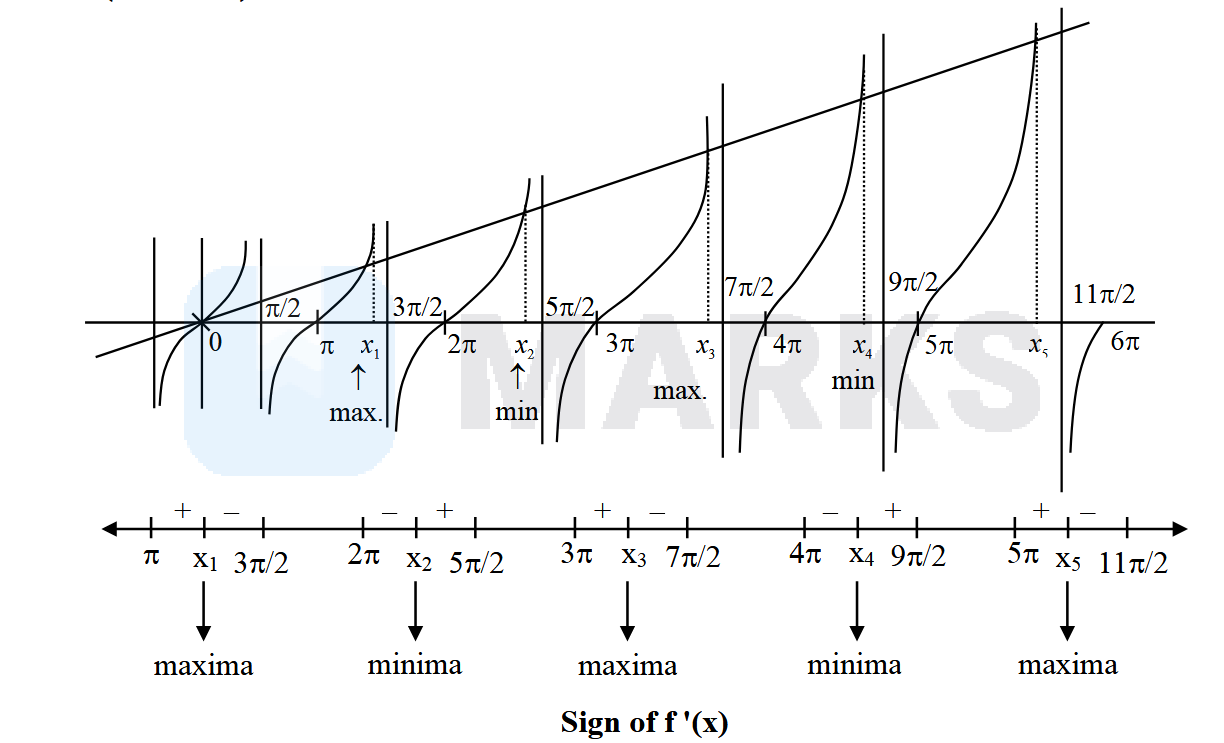
Options (C) \& (D) are also correct.
Hence, the correct answer is options: 'B', 'C', 'D'.