Q92 / 160 · AP EAMCET 2010 · Mathematics
Let $R$ denote the set of all real numbers and $R^{+}$denote the set of all positive real numbers. For the subsets $A$ and $B$ of $R$ define $f: A \rightarrow B$ by $f(x)=x^2$ for $x \in A$. Observe the two lists given below

- A
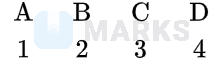
- B
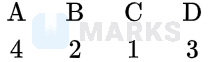
- Correct answerC

- D
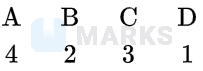
Solution
Given, $f(x)=-x^2, f: A \rightarrow B$
where, $A$ and $B \in R$
$R \rightarrow$ Real No's $x \in A$
Here, the domain of the function is positive real number only
ie, Domain $=A \in R^{+}$
Example $\{1,2,3, \ldots\}$ and $B=\{1,4,9, \ldots\}$
Both set have $f: A \rightarrow B$ unique image.
But, $A=\{-1,1,2, \ldots\}$ and $B=\{1,1,4, \ldots\}$
In $f: A \rightarrow B$ have not unique image and for Range $x^2=y, x= \pm \sqrt{y}$
ie, (Range $\in R^{+}$)
In onto function the (Range $=$ Co-domain $=B$ ) ie, $\left(B \in R^{+}\right)$
So,
(A) $f$ is one-one and onto, if $A=B=R^{+}$
(B $f$ is one-one but not onto, if $A=R^{+}, B=R$
(C) $f$ is onto but not one-one, if $A=R, B=R^{+}$
(D) $f$ is neither one-one nor onto, if $A=B=R$
Hence, the answer is
$(\mathrm{A}) \rightarrow 4,(\mathrm{~B}) \rightarrow 1,(\mathrm{C}) \rightarrow 3,(\mathrm{D}) \rightarrow 2$
Hence, the correct answer is option: 'C'.