Q26 / 75 · JEE Main 2025 (24 Jan Shift 1) · Mathematics
Let circle $C$ be the image of $x^2+y^2-2 x+4 y-4=0$ in the line $2 x-3 y+5=0$ and $A$ be the point on $C$ such that $O A$ is parallel to $x$-axis and $A$ lies on the right hand side of the centre $O$ of $C$. If $B(\alpha, \beta)$, with $\beta \lt 4$, lies on $C$ such that the length of the are $A B$ is $(1 / 6)^{\text {th }}$ of the perimeter of $C$, then $\beta-\sqrt{3} \alpha$ is equal to
- A$3+\sqrt{3}$
- Correct answerB$4$
- C$4-\sqrt{3}$
- D$3$
Solution
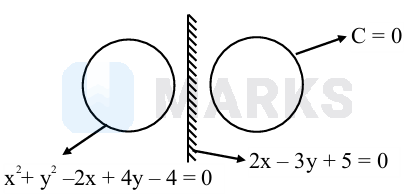
Centre $(1,-2), r=3$ Reflection of $(1,-2)$ about $2 x-3 y+5=0$ $\begin{aligned} & \frac{x-1}{2}=\frac{y+2}{-3}=\frac{-2(2+6+5)}{13}=-2 \\ & x=-3, y=4 \end{aligned}$ Equation of circle ' C ' $C:(x+3)^2+(y-4)^2=9$ A.T.Q.
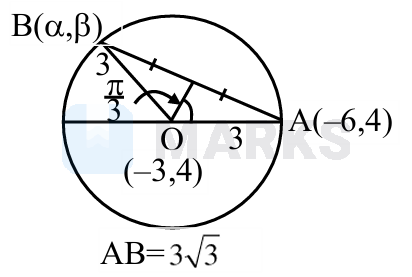
$\begin{aligned} & \ell(\operatorname{arcAB})=\frac{1}{6} \times 2 \pi \mathrm{r} \\ & \mathrm{r} \theta=\frac{1}{6} \times 2 \pi \mathrm{r} \\ & \theta=\frac{\pi}{3} \\ & (\alpha+6)^2+(\beta-4)^2=27 \\ & \frac{(\alpha+3)^2 \pm(\beta-4)^2=9}{(\alpha+6)^2-(\alpha+3)^2=18} \\ & \Rightarrow 6 \alpha=-9\end{aligned}$ $\begin{aligned} & \Rightarrow \alpha=\frac{-3}{2}, \beta=\left(4-\frac{3 \sqrt{3}}{2}\right) \\ & \therefore \beta-\sqrt{3} \alpha \\ & \left(4-\frac{3 \sqrt{3}}{2}\right)+\frac{3 \sqrt{3}}{2} \\ & =4\end{aligned}$
Hence, the correct answer is option: 'B'.