Q119 / 160 · JIPMER 2011 · Physics
Kirchhoff's law of junction, $\Sigma I=0$, is based on
- Aconservation of energy
- Correct answerBconservation of charge
- Cconservation of energy as well as charge
- Dconservation of momentum
Solution
Kirchhoff's first law states that in an electric circuit, the algebraic sum of the currents meeting at any junction in the circuit is zero.
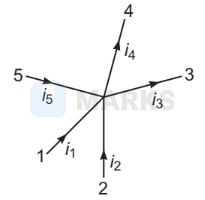 i.e., $\quad \Sigma i=0$
Hence, according to Kirchhoff's law
$i_1+i_2=i_3+i_4+i_5$
Thus, the sum of currents flowing towards the junction is equal to the sum of the currents flowing away from the junction. In other words, when a steady current flows in a circuit, then there is neither any accumulation of charge at any point in the circuit, nor any charge is removed from there. Thus, Kirchhoff's first law expresses the conservation of charge.
i.e., $\quad \Sigma i=0$
Hence, according to Kirchhoff's law
$i_1+i_2=i_3+i_4+i_5$
Thus, the sum of currents flowing towards the junction is equal to the sum of the currents flowing away from the junction. In other words, when a steady current flows in a circuit, then there is neither any accumulation of charge at any point in the circuit, nor any charge is removed from there. Thus, Kirchhoff's first law expresses the conservation of charge.Hence, the correct answer is option: 'B'.