Q38 / 160 · AP EAMCET 2023 (17 May Shift 1) · Chemistry
In the reaction, if $\mathrm{X}$ is the reagent and $\mathrm{Y}$ is the product, which of the following is not feasible?
In the reaction, if $\mathrm{X}$ is the reagent and $\mathrm{Y}$ is the product, which of the following is not feasible?
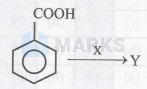
- A$\mathrm{X}=$ Conc. $\mathrm{HNO}_3+$ Con. $\mathrm{H}_2 \mathrm{SO}_4$; $\mathrm{Y}=3-$ Nitrobenzoic acid
- B$\mathrm{X}=\mathrm{Br}_2 / \mathrm{Fe} \quad \mathrm{Y}=3-$ Bromobenzoic acid
- C$\mathrm{X}=\mathrm{NaOH}, \mathrm{CaO} \quad \mathrm{Y}=$ Benzene
- Correct answerD$\mathrm{X}=\mathrm{CH}_3 \mathrm{Cl} / \mathrm{AlCl}_3 \quad \mathrm{Y}=3-$ Methylebenzoic acid
Solution
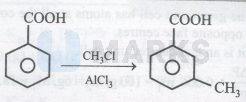
This reaction is not feasible because the $-\mathrm{COOH}$ group interacts with the lewis acid $\mathrm{AlCl}_3$ and forms acylium ion instead of the usual electrophilic substitution at the ring.
Hence, the correct answer is option: 'D'.