Q80 / 110 · VITEEE 2022 · Physics
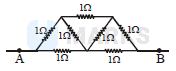
In the network shown in the Fig, each resistance is \(1 \Omega\). The effective resistance between \(A\) and \(B\) is
- A\(\frac{4}{3} \Omega\)
- B\(\frac{3}{2} \Omega\)
- C\(7 \Omega\)
- Correct answerD\(\frac{8}{7} \Omega\)
Solution
At A current is distributed and at B currents are collected. Between A and B, the distribution is symmetrical. It has been shown in the figure. It appears that current in \(\mathrm{AO}\) and \(\mathrm{OB}\) remains same. At \(\mathrm{O}\), current \(\mathrm{i}_4\) returns back without any change. If we detach \(\mathrm{O}\) from \(\mathrm{AB}\) there will not be any change in distribution.
Now, CO & OD will be in series hence its total resistance \(=2 \Omega\)
It is in parallel with \(\mathrm{CD}\), so, equivalent resistance
\(=\frac{2 \times 1}{2+1}=\frac{2}{3} \Omega\)
This equivalent resistance is in series with \(\mathrm{AC}\) & \(\mathrm{DB}\), so, total resistance
\(=\frac{2}{3}+1+1=\frac{8}{3} \Omega\)
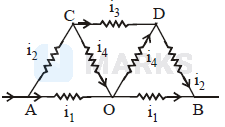
Now \(\frac{8}{3} \Omega\) is parallel to \(\mathrm{AB}\), that is, \(2 \Omega\), so total resistance \(=\frac{8 / 3 \times 2}{8 / 3+2}=\frac{16 / 3}{14 / 3}=\frac{16}{14}=\frac{8}{7} \Omega\) [Alt: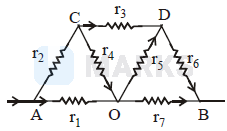
Between \(\mathrm{C}\) & D, the equivalent resistance is given by \(1 / \mathrm{r}=\frac{1}{\mathrm{r}_3}+\frac{1}{\left(\mathrm{r}_4+\mathrm{r}_5\right)}=1+\frac{1}{2}=\frac{3}{2}\) Equivalent resistance along \(\mathrm{ACDB}=1+\frac{2}{3}+1=\frac{8}{3}\) \(\therefore\) Effective resistance between \(\mathrm{A}\) and \(\mathrm{B}\) is \(\left.\frac{1}{\mathrm{R}}=\frac{3}{8}+\frac{1}{2}=\frac{7}{8} \text { or } \mathrm{R}=\frac{8}{7}\right]\)
Now \(\frac{8}{3} \Omega\) is parallel to \(\mathrm{AB}\), that is, \(2 \Omega\), so total resistance \(=\frac{8 / 3 \times 2}{8 / 3+2}=\frac{16 / 3}{14 / 3}=\frac{16}{14}=\frac{8}{7} \Omega\) [Alt:
Between \(\mathrm{C}\) & D, the equivalent resistance is given by \(1 / \mathrm{r}=\frac{1}{\mathrm{r}_3}+\frac{1}{\left(\mathrm{r}_4+\mathrm{r}_5\right)}=1+\frac{1}{2}=\frac{3}{2}\) Equivalent resistance along \(\mathrm{ACDB}=1+\frac{2}{3}+1=\frac{8}{3}\) \(\therefore\) Effective resistance between \(\mathrm{A}\) and \(\mathrm{B}\) is \(\left.\frac{1}{\mathrm{R}}=\frac{3}{8}+\frac{1}{2}=\frac{7}{8} \text { or } \mathrm{R}=\frac{8}{7}\right]\)
Hence, the correct answer is option: 'D'.