Q127 / 180 · AIIMS 2002 · Physics
In the given figure, the capacitance $C_1, C_3, C_4$, $\mathrm{C}_5$ have a capacitance $4 \mu \mathrm{F}$ each. If
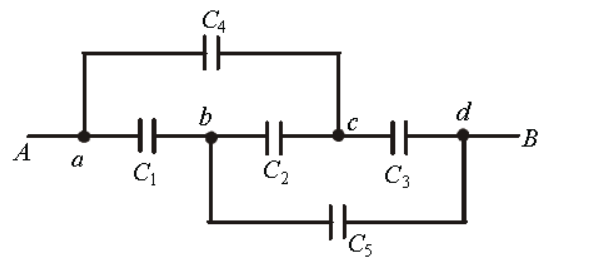
the capacitor $C_2$ has a capacitance $10 \mu \mathrm{F}$, then effective capacitance between $A$ and $B$ will be
the capacitor $C_2$ has a capacitance $10 \mu \mathrm{F}$, then effective capacitance between $A$ and $B$ will be
- A$2 \mu \mathrm{F}$
- B$6 \mu \mathrm{F}$
- Correct answerC$4 \mu \mathrm{F}$
- D$8 \mu \mathrm{F}$.
Solution
Capacitance of capacitors $C_1, C_3, C_4$, $C_5=4 \mu \mathrm{F}$ each and capacitance of capacitor $C_2=10 \mu \mathrm{F}$. If a battery is applied $\operatorname{across} A$ and $B$, the points $b$ and $c$ will be at the same potential (since $C_1$ $=C_4=C_3=C_5=4 \mu \mathrm{F}$ ). Therefore no charge flows through $C_2$. We have the capacitors $C_1$ and $C_5$ in series. Therefore their equivalent capacitance,
$$
C^{\prime}=\frac{C_1 \times C_5}{C_1+C_5}=\frac{4 \times 4}{4+4}=2 \mu \mathrm{F}
$$
Similarly, $C_4$ and $C_3$ are in series. Therefore their equivalent capacitance,
$$
C^{\prime \prime}=\frac{C_3 \times C_4}{C_3+C_4}=\frac{4 \times 4}{4+4}=2 \mu \mathrm{F} .
$$
Now $C^{\prime}$ and $C^{\prime \prime}$ are in parallel. Therefore effective capacitance between $A$ and $B$
$$
=C^{\prime}+C^{\prime \prime}=2+2=4 \mu \mathrm{F} \text {. }
$$
Hence, the correct answer is option: 'C'.