Q110 / 180 · AIIMS 2010 · Physics
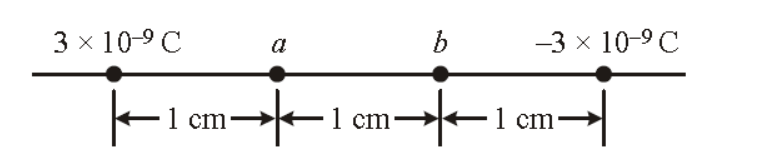
In figure, a particle having mass $m=5 \mathrm{~g}$ and charge $q^{\prime}=2 \times 10^{-9} \mathrm{C}$ starts from rest at point $a$ and moves in a straight line to point $b$. What is its speed $v$ at point $b$ ?
- A$2.65 \mathrm{cms}^{-1}$
- B$3.65 \mathrm{cms}^{-1}$
- Correct answerC$4.65 \mathrm{cms}^{-1}$
- D$5.65 \mathrm{cms}^{-1}$
Solution
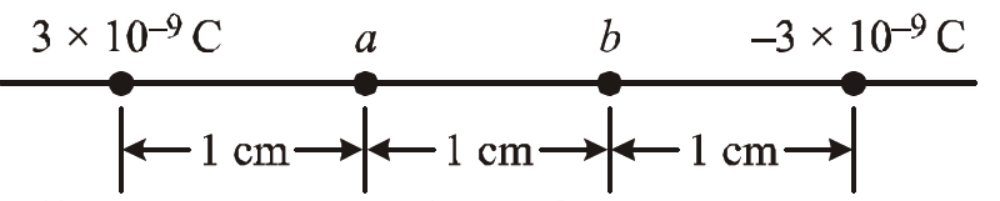
According to conservation of energy, we get $K_a+U_a=K_b+U_b$ Here, $K_a=0$ and the potential energies are $U_a=q^{\prime} V_a$ and $U_b=q^{\prime} V_b$ $$ \begin{aligned} & \therefore 0+q^{\prime} V_a=\frac{1}{2} m v^2+q^{\prime} V_b \\ & \text { or } v=\sqrt{\frac{2 q^{\prime}\left(V_a-V_b\right)}{m}} \\ & V_a=\left(9.0 \times 10^9 \mathrm{Nm}^2 \mathrm{C}^{-2}\right) \end{aligned} $$ $$ \begin{array}{r} \left(\frac{3 \times 10^{-9} \mathrm{C}}{0.01 \mathrm{~m}}+\frac{-3 \times 10^{-9} \mathrm{C}}{0.02 \mathrm{~m}}\right)=1350 \mathrm{~V} \\ V_b=\left(9.0 \times 10^9 \mathrm{Nm}^2 \mathrm{C}^{-2}\right) \\ \left(\frac{3 \times 10^{-9} \mathrm{C}}{0.02 \mathrm{~m}}+\frac{-3 \times 10^{-9} \mathrm{C}}{0.01 \mathrm{~m}}\right)=-1350 \mathrm{~V} . \end{array} $$ $$ \begin{aligned} \therefore & v=\sqrt{\frac{2\left(2 \times 10^{-9} \mathrm{C}\right)(2700 \mathrm{~V})}{5 \times 10^{-3} \mathrm{~kg}}}=4.65 \times 10^{-2} \mathrm{~m} \mathrm{~s}^{-1} \\ & =4.65 \mathrm{~cm} \mathrm{~s}^{-1} \end{aligned} $$
Hence, the correct answer is option: 'C'.