Q70 / 160 · TS EAMCET 2020 (14 Sep Shift 2) · Mathematics
If $\mathbf{a}$ and $\mathbf{b}$ represent two non collinear vectors, the equation $\mathbf{r}=t \mathbf{a}+(\mathrm{l}-t) \mathbf{b}$ represents
- Correct answerAa point on the third side of a triangle for which $a, b$ are two sides, only when $0 \leq t \leq 1$
- Ba point on the line joining the points whose position vectors are a and b
- Ca vector in the plane of $\mathrm{a}, \mathrm{b}$ only when $t>1$
- Da vector in the plane parallel to the plane of a and b, only when $-1 \leq t \leq 1$
Solution
We have, $\mathbf{r}=t \mathbf{a}+(\mathbf{l}-t) \mathbf{b}$, where $\mathbf{a}$ and $\mathbf{b}$ are two non collinear vector, $\mathbf{r}-\mathbf{b}=t(\mathbf{a}-\mathbf{b})$
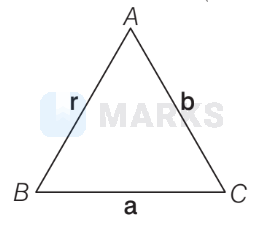
Clearly, $\mathbf{r}$ is a point on the third side of triangle where $\mathbf{a}, \mathbf{b}$ are two sides of triangle when $t \in[0,1]$
Clearly, $\mathbf{r}$ is a point on the third side of triangle where $\mathbf{a}, \mathbf{b}$ are two sides of triangle when $t \in[0,1]$
Hence, the correct answer is option: 'A'.