Q33 / 180 · COMEDK 2026 (9 May Shift 2) · Chemistry
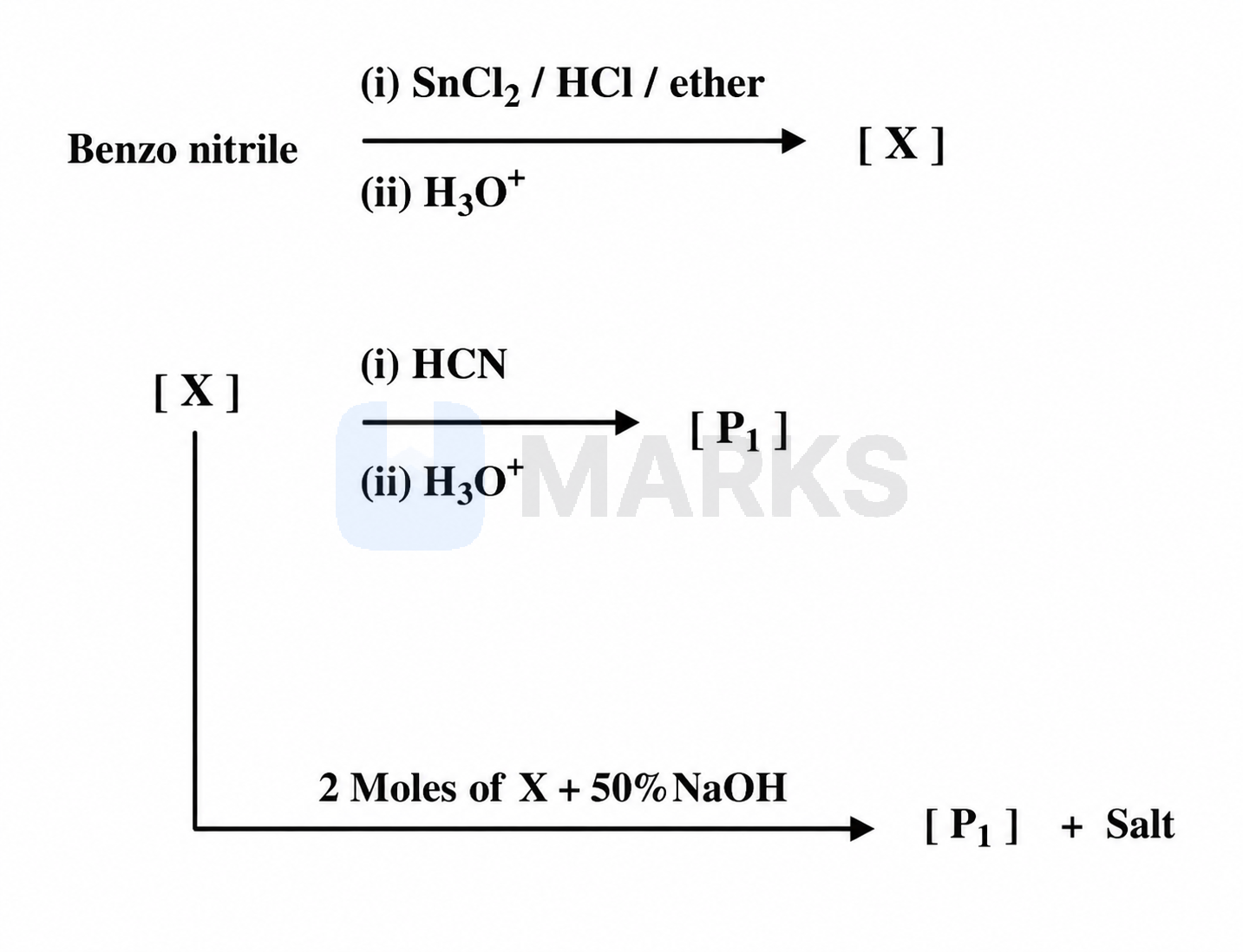
Identify products [P$_1$] and [P$_2$] formed when Benzonitrile undergoes the following reactions.
- A[P$_1$] Phenol and [P$_2$] Sodium benzoate
- Correct answerB[P$_1$] $\alpha$–Hydroxy phenylacetic acid and [P$_2$] Benzyl alcohol
- C[P$_1$] Benzoyl chloride and [P$_2$] Acetophenone
- D[P$_1$] Acetophenone and [P$_2$] Benzoic acid
Solution
1. Formation of [X]: Benzonitrile ($C_6H_5CN$) undergoes Stephen reduction when treated with $SnCl_2/HCl$ in ether, forming an imine intermediate. Subsequent acid hydrolysis ($H_3O^+$) yields benzaldehyde ($C_6H_5CHO$). Thus, [X] is benzaldehyde.
2. Formation of [P$_1$]: Benzaldehyde reacts with $HCN$ to undergo nucleophilic addition, forming benzaldehyde cyanohydrin ($C_6H_5CH(OH)CN$). Acid hydrolysis ($H_3O^+$) of the nitrile group converts it into a carboxylic acid group, yielding $\alpha$-hydroxy phenylacetic acid ($C_6H_5CH(OH)COOH$). Thus, [P$_1$] is $\alpha$-hydroxy phenylacetic acid.
3. Formation of [P$_2$]: Benzaldehyde does not have any $\alpha$-hydrogen atoms. When treated with a concentrated base ($50\%\ NaOH$), it undergoes the Cannizzaro reaction (a disproportionation reaction). Two moles of benzaldehyde react to form one mole of benzyl alcohol ($C_6H_5CH_2OH$) and one mole of sodium benzoate ($C_6H_5COO^-Na^+$), which is the salt. Thus, [P$_2$] is benzyl alcohol.
Answer: [P$_1$] $\alpha$–Hydroxy phenylacetic acid and [P$_2$] Benzyl alcohol
Hence, the correct answer is option: 'B'.