Q20 / 100 · BITSAT 2024 (Memory Based Paper 2) · Chemistry
Identify, from the following, the diamagnetic, tetrahedral complex
- A$\left[\mathrm{Ni}(\mathrm{Cl})_4\right]^{2-}$
- B$\left[\mathrm{Co}\left(\mathrm{C}_2 \mathrm{O}_4\right)_3\right]^3$
- C$\left[\mathrm{Ni}(\mathrm{CN})_4\right]^{2-}$
- Correct answerD$\left[\mathrm{Ni}(\mathrm{CO})_4\right]$
Solution
(a) Ni in $\left[\mathrm{Ni}(\mathrm{Cl})_4\right]^{2-}$ exist as $\mathrm{Ni}^{2+}$ ion.
Cl is a weak field ligand (high spin). It will not cause pairing of electrons.
Hence, configuration of $\left[\mathrm{Ni}(\mathrm{Cl})_4\right]^{2-}$ is
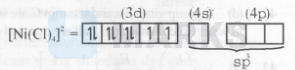 Tetrahedral with two unpaired electrons (i.e., paramagnetic) and has $s p^3$ hybridisation.
(b) In $\left[\mathrm{Co}\left(\mathrm{C}_2 \mathrm{O}_4\right)_3\right]^{3-},\left(\mathrm{C}_2 \mathrm{O}_4\right)_3^{2-}$ is a bidentate ligand thus, give octahedral structure.
(c) In $\left[\mathrm{Ni}(\mathrm{CN})_4\right]^{2-}$, Ni exist as $\mathrm{Ni}^{2+}$ ion.
$\mathrm{CN}^{-}$is a strong field ligand (low spin). Causes pairing of electrons of $3 d$ orbital.
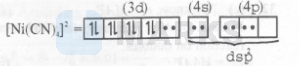 Hence, the structure of is square planar and it is diamagnetic.
(d) In $\left[\mathrm{Ni}(\mathrm{CO})_4\right]$, Ni has zero oxidation state. i.e.,
 CO is a strong field ligand causes rearrangement and pairing of electrons of $3 d$ and $4 s$ orbital.
 Structure of $\mathrm{Ni}\left(\mathrm{CO}_4\right)$ is tetrahedral with $s p^3$ hybridisation and it is diamagnetic.
Hence, (4) is the correct answer.
Tetrahedral with two unpaired electrons (i.e., paramagnetic) and has $s p^3$ hybridisation.
(b) In $\left[\mathrm{Co}\left(\mathrm{C}_2 \mathrm{O}_4\right)_3\right]^{3-},\left(\mathrm{C}_2 \mathrm{O}_4\right)_3^{2-}$ is a bidentate ligand thus, give octahedral structure.
(c) In $\left[\mathrm{Ni}(\mathrm{CN})_4\right]^{2-}$, Ni exist as $\mathrm{Ni}^{2+}$ ion.
$\mathrm{CN}^{-}$is a strong field ligand (low spin). Causes pairing of electrons of $3 d$ orbital.
Hence, the structure of is square planar and it is diamagnetic.
(d) In $\left[\mathrm{Ni}(\mathrm{CO})_4\right]$, Ni has zero oxidation state. i.e.,
CO is a strong field ligand causes rearrangement and pairing of electrons of $3 d$ and $4 s$ orbital.
Structure of $\mathrm{Ni}\left(\mathrm{CO}_4\right)$ is tetrahedral with $s p^3$ hybridisation and it is diamagnetic.
Hence, (4) is the correct answer.Hence, the correct answer is option: 'D'.