Q25 / 57 · JEE Advanced 2009 (Paper 2) · Mathematics
For the function $f(x)=x \cos \frac{1}{x}, x \geq 1$,
- Afor atleast one $x$ in the interval $[1, \infty)$, $f(x+2)-f(x) < 2$
- Correct answerB$\lim _{x \rightarrow \infty} f^{\prime}(x)=1$
- Correct answerCfor all $x$ in the interval $[1, \infty)$, $f(x+2)-f(x)>2$
- Correct answerD$f^{\prime}(x)$ is strictly decreasing in the interval $[1, \infty)$
Solution
Given, $f(x)=x \cos \frac{1}{x}, x \geq 1$
$$
\begin{aligned}
& \Rightarrow \quad f^{\prime}(x)=\frac{1}{x} \sin \frac{1}{x}+\cos \frac{1}{x} \\
& \Rightarrow \quad f^{\prime \prime}(x)=-\frac{1}{x^3} \cos \left(\frac{1}{x}\right)
\end{aligned}
$$
Now, $\lim _{x \rightarrow \infty} f^{\prime}(x)=0+1=1$
$\Rightarrow$ Option (b) is correct.
Now, $\quad x \in[1, \infty) \Rightarrow \frac{1}{x} \in(0,1]$
$\Rightarrow f^{\prime \prime}(x) < 0 \Rightarrow$ Option (d) is correct.
As $f^{\prime}(1)=\sin 1+\cos 1>1$
$f^{\prime}(x)$ is strictly decreasing and $\lim _{x \rightarrow \infty} f^{\prime}(x)=1$
So, graph of $f^{\prime}(x)$ is shown as below.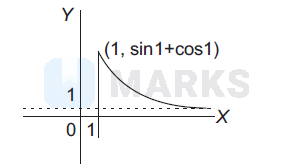
Now, in $[x, x+2], x \in[1, \infty), f(x)$ is continuous and differentiable so by LMVT, $$ f^{\prime}(x)=\frac{f(x+2)-f(x)}{2} $$ As $f^{\prime}(x)>1$ for all $x \in[1, \infty)$ $$ \begin{aligned} & \Rightarrow \quad \frac{f(x+2)-f(x)}{2}>1 \\ & \Rightarrow f(x+2)-f(x)>2 \quad \text { for all } x \in[1, \infty) \end{aligned} $$
Now, in $[x, x+2], x \in[1, \infty), f(x)$ is continuous and differentiable so by LMVT, $$ f^{\prime}(x)=\frac{f(x+2)-f(x)}{2} $$ As $f^{\prime}(x)>1$ for all $x \in[1, \infty)$ $$ \begin{aligned} & \Rightarrow \quad \frac{f(x+2)-f(x)}{2}>1 \\ & \Rightarrow f(x+2)-f(x)>2 \quad \text { for all } x \in[1, \infty) \end{aligned} $$
Hence, the correct answer is options: 'B', 'C', 'D'.