Q58 / 75 · JEE Main 2026 (22 January Shift 2) · Physics
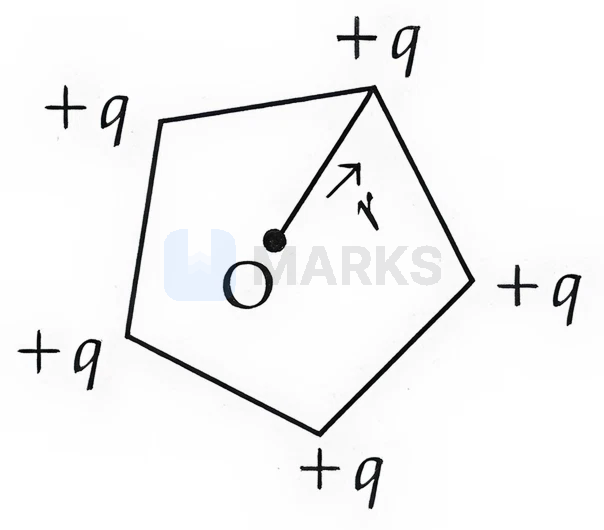
Five positive charges each having charge $q$ are placed at the vertices of a pentagon as shown in the figure. The electric potential $(V)$ and the electric field $(\vec{E})$ at the center $O$ of the pentagon due to these five positive charges are:
- A$V=\frac{5 q}{4 \pi \varepsilon_{o} r} \text { and } \vec{E}=\frac{5 \sqrt{3} q}{8 \pi \varepsilon_{o} r^{2}} \hat{r}$
- Correct answerB$V=\frac{5 q}{4 \pi \varepsilon_{o} r} \text { and } \vec{E}=0$
- C$V=0 \text { and } \vec{E}=0$
- D$V=\frac{5 q}{4 \pi \varepsilon_{o} r} \text { and } \vec{E}=\frac{5 q}{4 \pi \varepsilon_{\mathrm{o}} r^{2}} \hat{r}$
Solution
The electric potential at center O is the scalar sum of contributions from all 5 charges.
Each charge is equidistant from center, so $V = 5 cdot \frac{kq}{r} = \frac{5q}{4\pi\epsilon_0 r}$.
The electric field is a vector sum of field vectors from all 5 charges.
Due to 5-fold rotational symmetry of a regular pentagon, the 5 field vectors point radially outward from center, equally spaced at 72° angles.
The vector sum of 5 equally spaced unit vectors is zero, so $\vec{E} = 0$.
Hence, the correct answer is option: 'B'.