Q119 / 180 · NEET 2026 (Cancelled) · Physics
Five capacitors of capacitances $C_1 = C_2 = C_3 = C_4 = 10\ \mu F$ and $C_5 = 2.5\ \mu F$ are connected as shown, along with a battery of $50$ V.
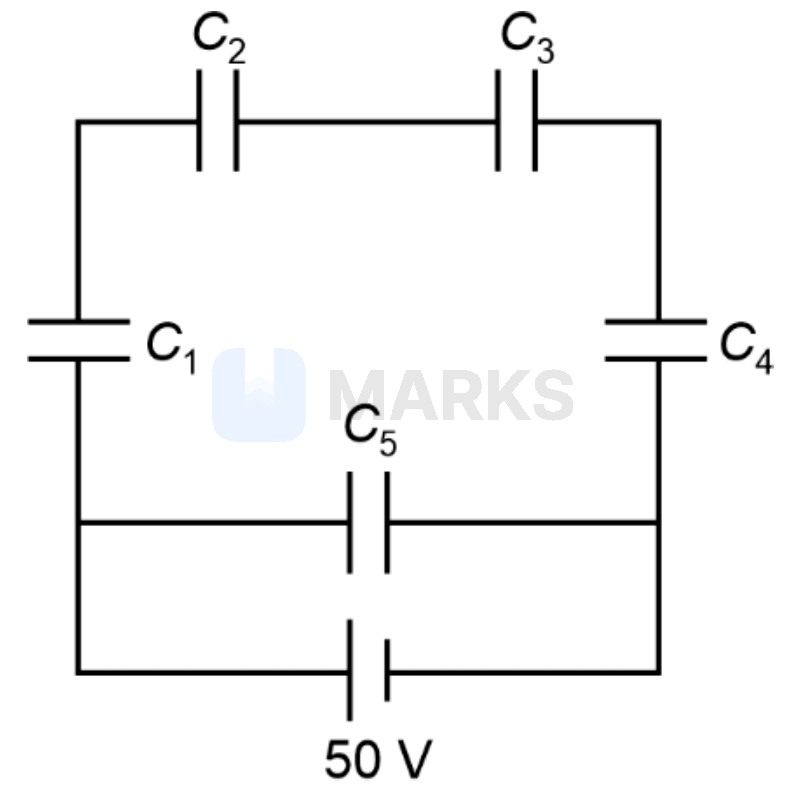
The equivalent capacitance and the charges on each capacitor respectively are :
The equivalent capacitance and the charges on each capacitor respectively are :
- A$5\ \mu F$, $125\ \mu C$ on $C_1$ to $C_4$ and $25\ \mu C$ on $C_5$
- Correct answerB$5\ \mu F$, $125\ \mu C$ on all capacitors
- C$5\ \mu F$, $250\ \mu C$ on all capacitors
- D$4\ \mu F$, $250\ \mu C$ on $C_1$ to $C_4$ and $125\ \mu C$ on $C_5$
Solution
From the given circuit diagram, the capacitors $C_1, C_2, C_3$, and $C_4$ are connected in series. This series combination is connected in parallel with the capacitor $C_5$. The entire combination is connected across the $50\text{ V}$ battery.
Let $C_s$ be the equivalent capacitance of the series branch containing $C_1, C_2, C_3$, and $C_4$.
$\dfrac{1}{C_s} = \dfrac{1}{C_1} + \dfrac{1}{C_2} + \dfrac{1}{C_3} + \dfrac{1}{C_4}$
$\dfrac{1}{C_s} = \dfrac{1}{10} + \dfrac{1}{10} + \dfrac{1}{10} + \dfrac{1}{10} = \dfrac{4}{10}\ \mu\text{F}^{-1}$
$C_s = 2.5\ \mu\text{F}$
The total equivalent capacitance $C_{eq}$ of the circuit is the sum of the parallel capacitances $C_s$ and $C_5$:
$C_{eq} = C_s + C_5 = 2.5\ \mu\text{F} + 2.5\ \mu\text{F} = 5\ \mu\text{F}$
The voltage across the series branch is equal to the battery voltage, $V = 50\text{ V}$.
The charge on the series combination is:
$Q_s = C_s \times V = 2.5\ \mu\text{F} \times 50\text{ V} = 125\ \mu\text{C}$
Since $C_1, C_2, C_3$, and $C_4$ are in series, they each carry the same charge $Q_s$.
Therefore, charge on $C_1, C_2, C_3, C_4 = 125\ \mu\text{C}$.
The voltage across capacitor $C_5$ is also $50\text{ V}$.
The charge on $C_5$ is:
$Q_5 = C_5 \times V = 2.5\ \mu\text{F} \times 50\text{ V} = 125\ \mu\text{C}$
Thus, the equivalent capacitance is $5\ \mu\text{F}$ and the charge on all capacitors is $125\ \mu\text{C}$.
Answer: $5\ \mu F$, $125\ \mu C$ on all capacitors
Hence, the correct answer is option: 'B'.